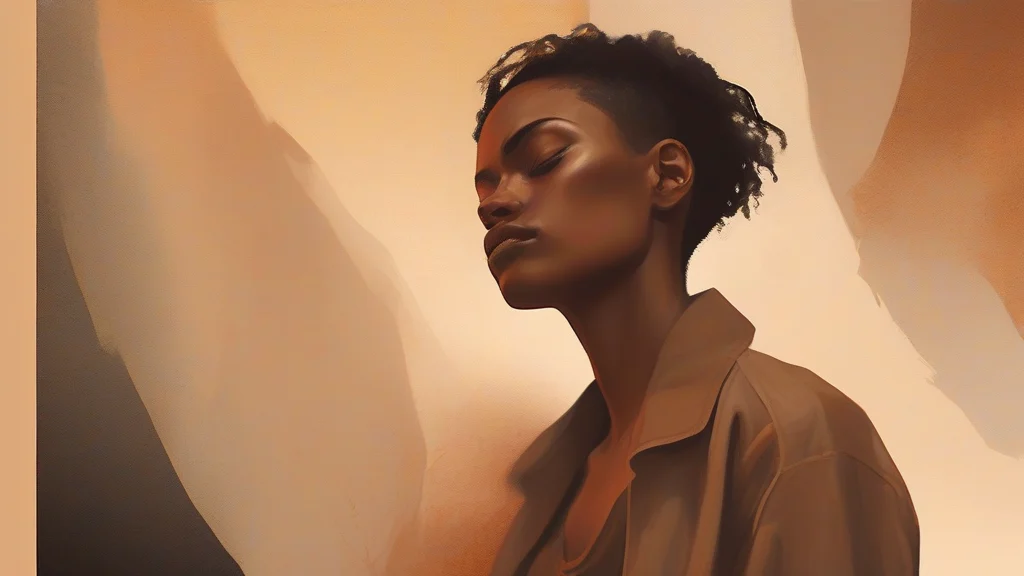
What does androgynous mean?
Androgynous describes something or someone that combines or blurs masculine and feminine qualities, whether in physical appearance, dress, behavior, or identity. Derived from the Greek roots for man ('anēr') and woman ('gunē'), the word has been part of English since at least the early seventeenth century. In contemporary usage it appears most often in conversations about fashion, popular culture, and gender expression — describing, for example, an androgynous haircut, an androgynous stage persona, or an androgynous sense of style. The term carries no inherent judgment; within artistic and progressive contexts it is often celebrated as a sign of freedom from rigid gender norms, though reactions vary across cultural settings. Closely related terms include 'androgyny' (the abstract quality), 'gender-neutral', and 'epicene'. Understanding 'androgynous' is useful because it captures a concept — the deliberate mingling of gender signals — that simpler words like 'masculine' or 'feminine' cannot express on their own.
adjectiveHaving both masculine and feminine characteristics or qualities, in appearance, manner, or identity; neither distinctly male nor female.
- Having the physical appearance or style combining both masculine and feminine features.
- (Of a person's identity or presentation) Identifying with or expressing both genders or neither.
"The model's androgynous look made her a favorite of avant-garde designers."
"David Bowie cultivated an androgynous stage persona that blurred conventional gender boundaries."
"The character was written as deliberately androgynous so that any reader could identify with them."
The word comes from Greek 'anēr' (man) plus 'gunē' (woman) — literally 'man-woman' fused into one term over two thousand years ago.
Reviewed by Deb Chak, Editor. AI-assisted content curated by RJS Tech Solutions LLP.
Etymology of androgynous
Androgynous derives from the ancient Greek 'andrógynos' (ἀνδρόγυνος), formed from 'anēr' meaning man and 'gunē' meaning woman. The Greek term passed into Latin as 'androgynus' and entered English in the early modern period, appearing by the early seventeenth century. Related words sharing the same root include 'androgen' (a hormone name using the same 'anēr' element) and 'android' (from Greek 'anēr' via Latinized forms).
Related word forms
How androgynous is actually used
In modern usage, especially since the late 20th century, 'androgynous' is frequently used in discussions of fashion, music, and gender identity. It is generally neutral to positive in connotation within these contexts, though it can carry pejorative undertones in conservative registers. The related noun 'androgyny' denotes the quality itself.
Easily confused with androgynous
A hermaphrodite (intersex) refers to an organism with physical reproductive anatomy of both sexes, while androgynous describes blended or ambiguous gender expression that may be purely stylistic or behavioral.
Epicene means lacking characteristics of either sex or applicable to either sex, whereas androgynous positively combines both masculine and feminine traits.