What does anhinga mean?
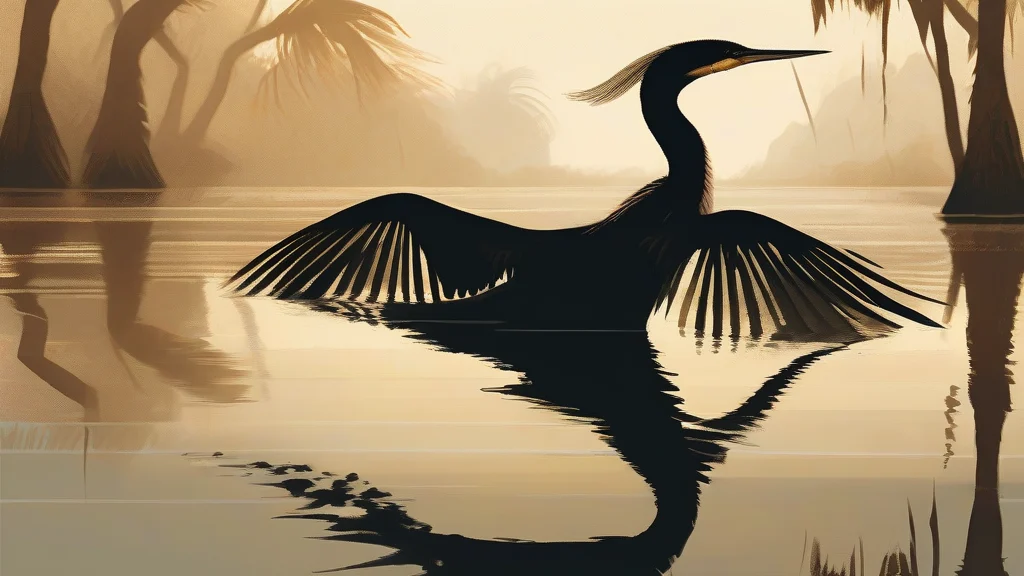
The anhinga is a large, slender waterbird found in the shallow freshwater swamps, marshes, and slow-moving rivers of the southeastern United States, Mexico, Central America, and much of South America. Dark-bodied with a very long, thin neck and a straight, pointed bill, it hunts by swimming almost fully submerged — often with only its head and neck visible above the surface, giving rise to its popular names 'snakebird' and 'water turkey.' Unlike ducks, its feathers are not heavily waterproofed, so after diving it perches conspicuously with its wings spread open to dry, a posture familiar to anyone who has visited Florida wetlands such as Everglades National Park's Anhinga Trail. It feeds chiefly on fish, which it spears with its bill before flipping them into the air and swallowing headfirst. The word comes from the Tupi language of Brazil via early European naturalists, and the name applies both to this American species and, more broadly, to its Old World relatives known as darters.
nounA long-necked fish-eating waterbird of the genus Anhinga (family Anhingidae), found in warm freshwater swamps and marshes of the Americas; also called the snakebird or American darter.
- The American darter, Anhinga anhinga, a long-necked waterbird of warm American swamps that swims submerged except for its head and neck and spreads its wings to dry.
"From our kayak we watched an anhinga perched on a snag, wings spread wide to dry in the sun."
"An anhinga surfaced with a fish speared on its dagger-like bill."
"Along the boardwalk at Everglades National Park, visitors can watch anhingas drying their outstretched wings in the trees."
Standard English pluralization; no irregular form exists.
"During the dry season, dozens of anhingas gather at the shrinking waterholes."
The anhinga swims so low in the water that only its snakelike neck shows above the surface — which is exactly why people call it the snakebird.
Reviewed by Deb Chak, Editor. AI-assisted content curated by RJS Tech Solutions LLP.
Etymology of anhinga
The word 'anhinga' entered English from Portuguese, which borrowed it from Tupi, an indigenous language of coastal Brazil, where it referred to the same long-necked waterbird. Early European naturalists recorded the indigenous name when describing Brazilian wildlife, and it was later formalized as the generic name Anhinga for the group of birds also known as darters or snakebirds. Its closest English relatives are not other common words but the parallel names applied to these birds, notably 'darter' and 'snakebird.'
How anhinga is actually used
Anhinga is used almost entirely in ornithological, naturalist, and nature-writing contexts rather than everyday conversation. In North America it is sometimes called the 'water turkey' or 'snakebird'; elsewhere the closely related species are generally called 'darters'. The plural is typically 'anhingas'.
Easily confused with anhinga
Cormorants are similar dark diving birds, but anhingas have a longer, thinner neck, a straight pointed bill rather than a hooked one, and often swim with only the head and neck above water.