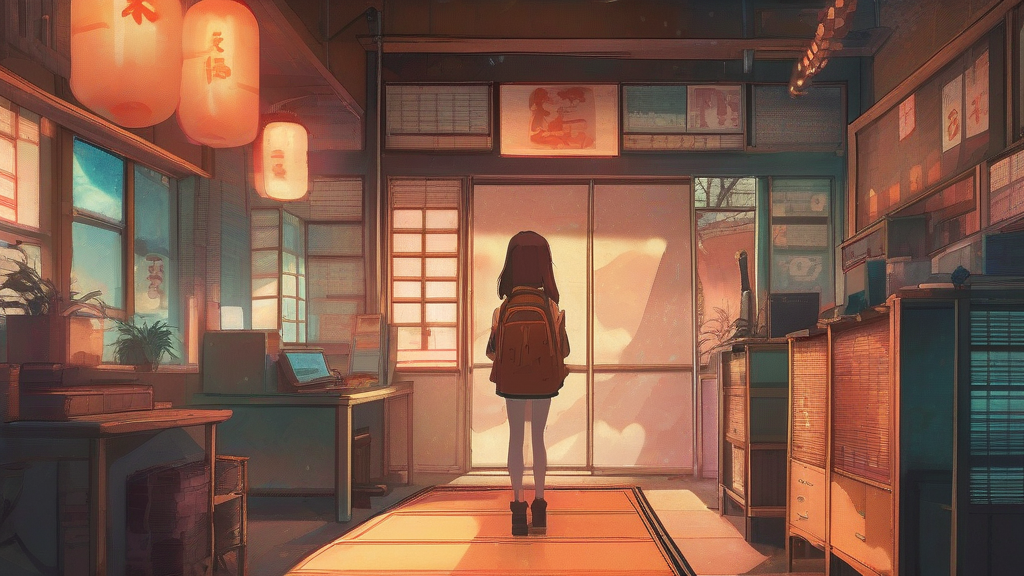
What does anime mean?
Anime is a style of animation that originated in Japan and has become one of the country's most influential cultural exports. Characterized by vibrant artwork, expressive characters, and storytelling that spans every genre from fantasy and science fiction to romance and drama, anime reaches audiences of all ages rather than catering only to children. Outside Japan, the word specifically refers to Japanese animation, though within Japan it serves as a general term for any animated work. Anime can describe the medium as a whole ('a fan of anime') or an individual production ('a classic anime series'). It is closely related to manga, Japanese comic books, which frequently serve as source material for adaptations. Since the late twentieth century, franchises such as those of Studio Ghibli and globally popular series have made anime a mainstream part of international popular culture, supported by dedicated streaming services, conventions, and fandom communities around the world.
nounA style of Japanese film and television animation, typically characterized by colorful graphics, distinctive character designs, and a wide range of genres aimed at both children and adults.
- Japanese-style animation, as a genre of film and television produced in Japan and characterized by its distinctive visual style.
- More broadly, an individual animated work or series in this style.
"She spent the weekend binge-watching her favorite anime series."
"Studio Ghibli's films introduced millions of viewers worldwide to the artistry of anime."
"He dressed as his favorite anime character for the convention."
Because the word entered English via Japanese, where it functions as a mass noun, many speakers treat 'anime' as uncountable and do not pluralize it; when counting individual works, phrases like 'three anime series' are common. The plural form 'animes' exists but is informal and less frequent.
"The festival screened dozens of anime from across the decades."
The word 'anime' is simply the Japanese abbreviation for 'animation' — so technically, in Japan, any cartoon counts as anime.
Reviewed by Deb Chak, Editor. AI-assisted content curated by RJS Tech Solutions LLP.
Etymology of anime
The word 'anime' comes from Japanese アニメ (anime), an abbreviated borrowing of the English word 'animation', which itself derives from the Latin 'anima' meaning breath or soul, via 'animare', to give life to. The Japanese abbreviation became established during the twentieth century as the domestic term for animated film and television. When Japanese animation gained an international audience, the Japanese term was re-borrowed into English, where it now specifically denotes animation of Japanese origin. It thus shares its ultimate root with words such as 'animate', 'animal', and 'magnanimous'.
How anime is actually used
In Japan, 'anime' (アニメ) is a generic term for all animation regardless of origin; outside Japan it specifically denotes Japanese animation. The word is used as both a mass noun (the medium) and a count noun (an individual show or film). Pluralization varies: 'anime' is often treated as invariant, though 'animes' appears informally.
Easily confused with anime
Manga refers to Japanese comic books and graphic novels, while anime refers to Japanese animated films and shows; many anime are adapted from manga.