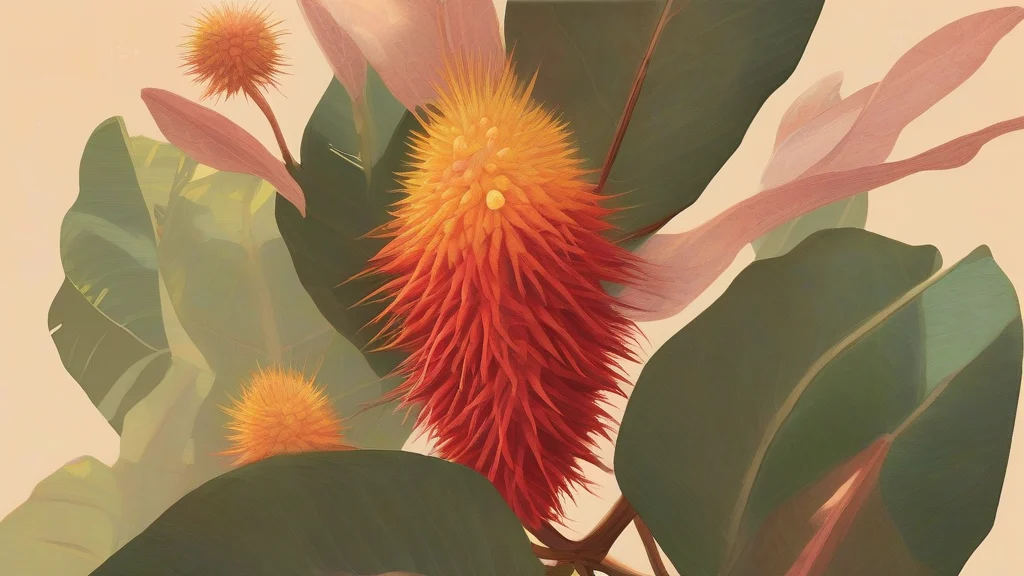
What does annatto mean?
Annatto refers both to a tropical American tree of the genus Bixa and to the vivid orange-red dye derived from its seeds. The tree produces spiny pods filled with small seeds coated in a pigment-rich pulp; these seeds are processed into powders, pastes, and oils used to lend a warm golden hue and a subtle, slightly peppery flavor to foods. Annatto is among the oldest natural food colorings still in commercial use, giving many cheeses, butter, margarine, and snack products their characteristic yellow-orange appearance. In Latin American and Caribbean cuisines it is a staple seasoning, often sold as achiote paste and blended into marinades, rice dishes, and stews. Because it imparts color far more strongly than flavor, annatto is frequently compared to saffron, though it costs a fraction as much. For cooks and food enthusiasts alike, it remains an accessible way to achieve rich, traditional coloring without synthetic additives.
nounA tropical American tree (Bixa orellana) bearing clusters of pinkish-white flowers and spiny red seed pods, whose seeds yield a yellow-orange dye and food coloring; also, the reddish-orange dye or paste made from those seeds, widely used to color and flavor foods such as cheese and butter.
- The tropical American shrub or small tree Bixa orellana, cultivated for its red seed pods.
- The orange-red dye, paste, or powder extracted from annatto seeds, used as a natural food coloring and mild flavoring.
"The cheesemaker stirred a pinch of annatto into the milk to give the cheddar its familiar golden hue."
"She ground the annatto seeds into a paste and rubbed it over the pork before roasting."
"Many commercial cheeses owe their orange tint not to age or quality but to a touch of annatto added during production."
Rarely pluralized in practice; annatto is usually treated as a mass noun when referring to the dye or seeds, so the plural form appears mainly in botanical contexts referring to multiple trees.
"The plantation's rows of annattos stretched toward the horizon, their spiny pods ripening in the sun."
Annatto has been called the 'poor man's saffron' — it's what makes your cheddar cheese orange, and it's been coloring food since long before artificial dyes existed.
Reviewed by Deb Chak, Editor. AI-assisted content curated by RJS Tech Solutions LLP.
Etymology of annatto
Annatto derives from the Carib word for the plant and its seeds, entering European languages via early Spanish and Portuguese contact with indigenous peoples of tropical America. The word was adopted into English in the seventeenth century, alongside related names such as achiote (from Nahuatl through Spanish), urucum (from Tupi-Guarani in Brazil), and roucou (from Carib through French). These parallel borrowings reflect how widely the plant and its dye were traded across different colonial spheres.
How annatto is actually used
Annatto is primarily encountered in culinary and botanical contexts. In cooking it appears under several names — achiote in Spanish-speaking regions, urucum in Brazil, roucou in parts of the Caribbean — which can cause confusion when following recipes. It is valued as one of the few natural food colorings still in widespread industrial use.
Easily confused with annatto
Saffron is a costly spice from crocus stigmas used for color and flavor, whereas annatto is a much cheaper seed-derived dye with a milder, slightly peppery taste.
Turmeric is a rhizome spice with a warm, bitter flavor used in curries, while annatto is a seed-based coloring agent with a subtler taste.