What does annealing mean?
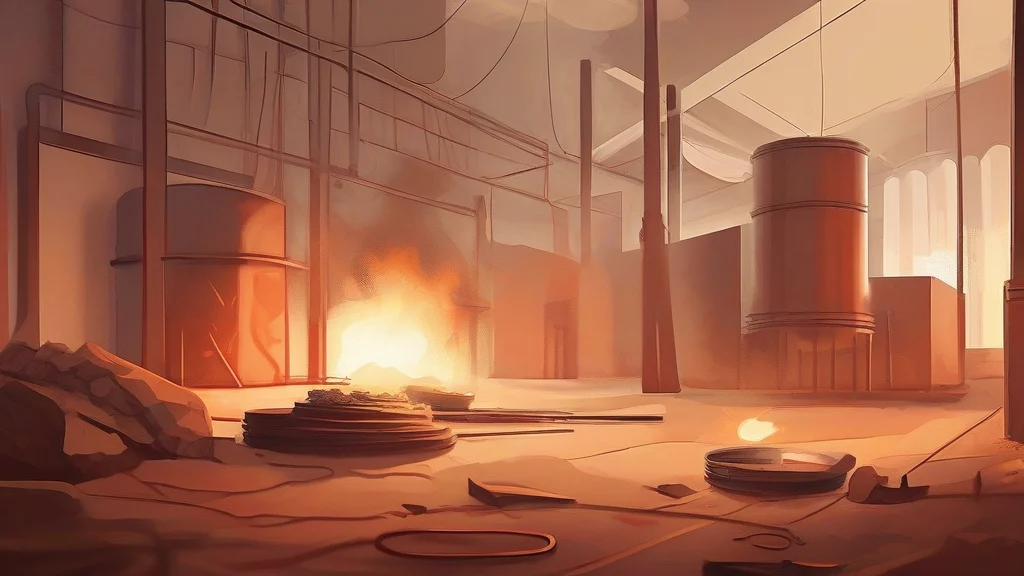
Annealing is the industrial process of heating a material—most often metal or glass—to a carefully chosen high temperature and then allowing it to cool very slowly. This controlled treatment relieves internal stresses, softens the material, refines its grain structure, and makes it tougher and far less likely to crack under later working or impact. A blacksmith might anneal steel so that it can be hammered and shaped without breaking, while a glassmaker anneals freshly blown glass in an oven to keep it from shattering spontaneously days later. The word also lives a second life in modern computing: 'simulated annealing' is an optimization technique that mimics this slow cooling to help algorithms settle into their best possible solutions. Technical rather than conversational, annealing nonetheless offers a vivid example of how patience and heat together produce strength—an idea so useful that engineers and programmers alike have adopted it as a guiding metaphor.
nounThe process of heating a material such as metal or glass to a high temperature and then cooling it slowly, typically in order to make it softer, tougher, or less brittle. More broadly, any analogous gradual process used to reduce internal stress or reach a stable state.
- The metallurgical process of heating and slowly cooling metal or glass to soften it or relieve internal stress.
- By analogy, any gradual optimization or stabilization process, especially simulated annealing in computer science.
"The bladesmith annealed the steel overnight so it could be hammered into shape without cracking."
"After casting, the glass was placed in an annealing oven for several hours to prevent it from shattering later."
"The researchers used simulated annealing to search the vast space of possible protein folds."
Rarely pluralized; usually treated as a mass noun describing a single process. Plural appears occasionally in technical literature referring to multiple distinct treatments.
"The report compared the annealings performed at each stage of production."
Computer scientists borrowed 'annealing' from blacksmiths: 'simulated annealing' lets algorithms cool down slowly to find optimal solutions, just as slow-cooled steel finds its strongest form.
Reviewed by Deb Chak, Editor. AI-assisted content curated by RJS Tech Solutions LLP.
Etymology of annealing
Annealing comes from the verb 'anneal', which descends from Old English 'onǣlan', meaning to set on fire or kindle, formed from the prefix 'on-' plus 'ǣlan', 'to burn'. That Germanic verb traces back to the ancient Indo-European root meaning 'to burn or kindle', which also produced Latin descendants such as 'aestus', heat, and hence English words like 'estival'. The metallurgical sense—treating metal by heat and slow cooling—was established in English by at least the early modern period.
Related word forms
How annealing is actually used
Primarily a technical term used in metallurgy, materials science, glassmaking, and computing; rarely encountered in casual conversation. The verb 'anneal' is more common in everyday technical writing than the noun 'annealing'.
Easily confused with annealing
Quenching cools hot metal rapidly, usually in water or oil, to make it hard and brittle, whereas annealing cools it slowly to soften it and relieve internal stresses.