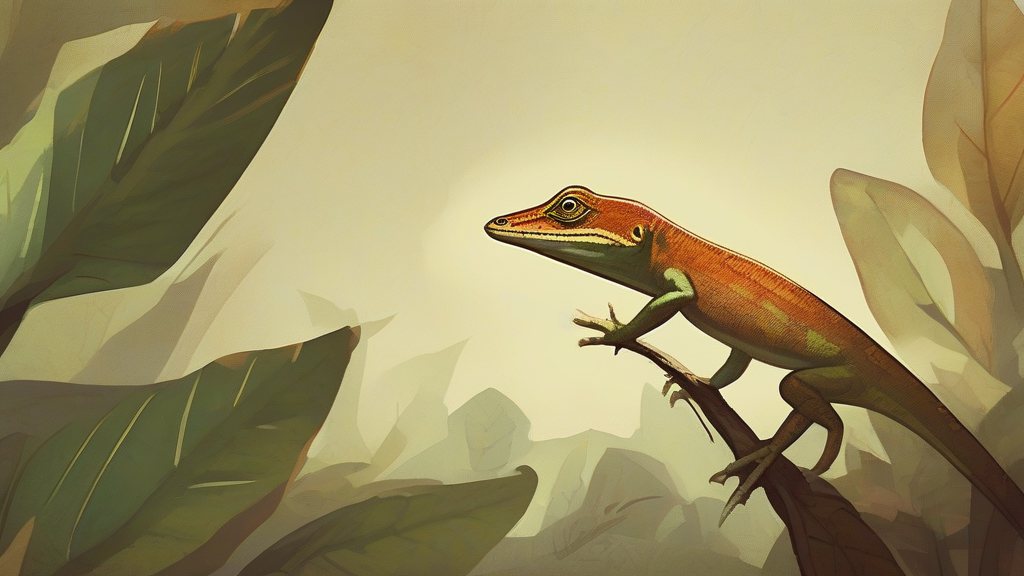
What does anole mean?
An anole is a small, slender, tree-dwelling lizard belonging to the large New World genus Anolis, found throughout the southeastern United States, the Caribbean, and parts of Central and South America. Typically insect-eating and active by day, anoles are best known for two traits: a limited ability to shift their skin colour between green and brown, and the colourful throat fan, or dewlap, that males extend to court females and defend territory. Because of the colour change, the common green anole is popularly nicknamed the 'American chameleon', although it is only distantly related to the true chameleons of Africa and Asia. Anoles are favourites among herpetologists as models for studying evolution and ecology — different island species famously evolved distinct limb shapes to suit different perches — and they are familiar backyard reptiles across much of the American South. The word itself entered English through French from a Caribbean indigenous source.
nounA small, slender arboreal lizard of the genus Anolis, native to the Americas and the Caribbean, known for its ability to change colour and for the brightly coloured throat fan (dewlap) displayed by males.
- Any small arboreal lizard of the genus Anolis (family Dactyloidae/Iguanidae), native to the southeastern United States, Central America, South America, and the Caribbean.
"A green anole basked on the fence post, puffing out its rosy dewlap."
"The green anole flashed its bright pink dewlap to warn off a rival male."
"Brown anoles, introduced from Cuba, have displaced green anoles from many Florida gardens."
The standard plural simply adds -s; no irregular form exists.
"Several anoles could be seen sunning themselves on the porch railing."
The green anole can turn brown in seconds — which is why Americans long mistook it for a chameleon.
Reviewed by Deb Chak, Editor. AI-assisted content curated by RJS Tech Solutions LLP.
Etymology of anole
The word 'anole' derives from 'anoli', a term recorded by early European observers in the Caribbean, ultimately taken from a language of the region's indigenous peoples (often cited as Cariban). It passed into French and then into English, where it was applied to the small colour-changing lizards of the West Indies and adjacent mainland. Its closest linguistic relatives are other borrowings from the same Caribbean source rather than classical Latin or Greek roots.
How anole is actually used
Chiefly used in North American natural-history contexts; the plural is usually 'anoles'. In casual American speech the green anole is often called an 'American chameleon', though this name is misleading since it is not a true chameleon.
Easily confused with anole
Chameleons are Old World lizards famous for colour change; anoles are New World lizards sometimes called 'American chameleons' but are not true chameleons.
Geckos are typically nocturnal lizards with adhesive toe pads and a chirping call, whereas anoles are diurnal, lack vocal calls, and have toe pads suited to climbing foliage.
Iguanas are large herbivorous lizards, while anoles are small insect-eating lizards, though both belong to the family Iguanidae in the broad sense.