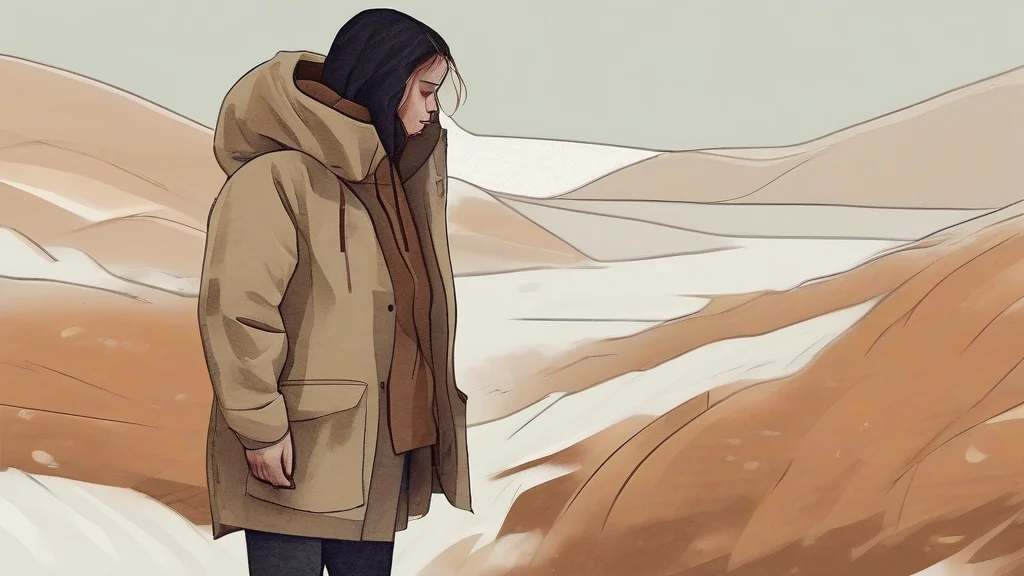
What does anorak mean?
An anorak is a hooded, waterproof or windproof jacket, usually cut as a pullover with a short front zip, designed for protection against rain, wind, and cold. The word entered English from Greenlandic Inuit, where annoraaq referred to the traditional hooded garment worn in the Arctic, and it became popular in mid-twentieth-century Britain for outdoor wear and school uniforms. Closely related terms include the parka, which is generally longer and more heavily insulated, and the cagoule, a British variant name for a lightweight hooded rain shell. Uniquely among clothing words, anorak also acquired a second life in British slang: there it denotes a person with an obsessive enthusiasm for a dry or unfashionable subject, such as railway timetables, a usage that has no real equivalent in American English. The garment sense remains standard worldwide, especially in outdoor and hiking contexts.
A hooded, waterproof or windproof jacket or coat, typically pullover-style with a partial front zip, originally based on Inuit Arctic garments.
"The hikers wore anoraks to shield themselves from the driving sleet."
In British slang, the word can also refer to a person obsessively interested in a niche topic.
(British slang) A person with an obsessive, often unfashionable enthusiasm for a narrow subject such as trainspotting.
"Only a true anorak could recite every station on that line from memory."
This figurative sense is chiefly British and informal, often mildly mocking.
Standard regular plural.
"Several anoraks hung dripping by the door after the storm."
The word 'anorak' comes straight from the Greenlandic Inuit language — and in Britain it doubles as slang for a boringly obsessive hobbyist.
Reviewed by Deb Chak, Editor. AI-assisted content curated by RJS Tech Solutions LLP.
Etymology of anorak
Anorak derives from the Greenlandic Inuit word annoraaq, the name for the traditional hooded upper garment worn by Arctic peoples. The word was adopted into English through contact with Greenland and Arctic exploration, becoming established in British English by the mid-twentieth century for waterproof outdoor jackets modeled on the Inuit original. It shares its linguistic heritage with other borrowings from Inuit languages, such as kayak and igloo.
How anorak is actually used
In British English the term carries a mild pejorative slang meaning, denoting someone with an obsessive, unfashionable hobby; this sense is largely absent in American usage, where the word refers only to the garment.
Easily confused with anorak
A parka is a longer, often insulated hooded coat extending toward the knees, while an anorak is typically a shorter, lighter pullover-style jacket.