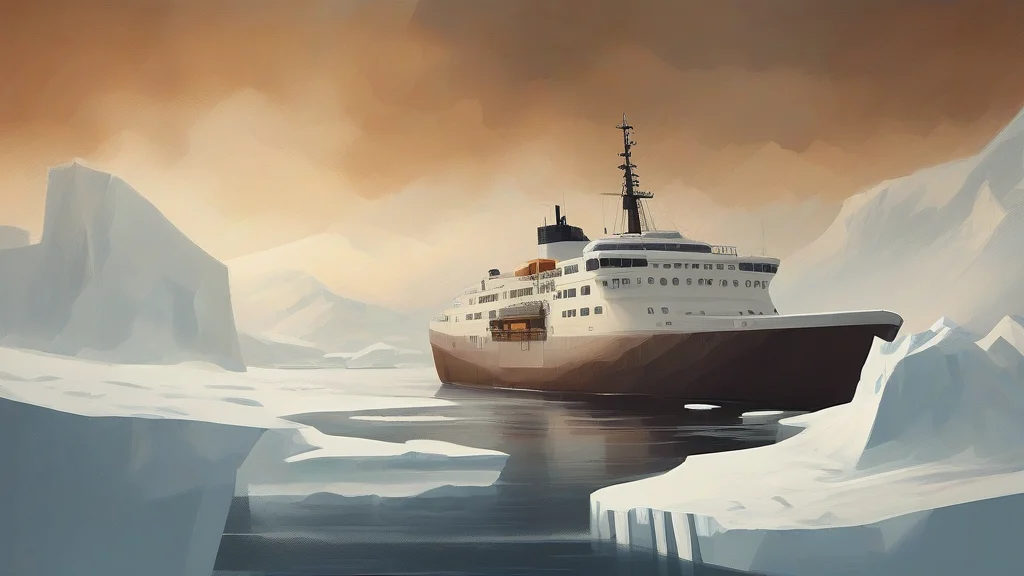
What does antarctic mean?
Antarctic is an adjective describing anything relating to the far southern polar region — the continent of Antarctica, the surrounding Southern Ocean, and the ice-covered lands and seas near the South Pole. In everyday use it most often appears in geographic and scientific contexts: expeditions, wildlife such as penguins and seals, and phenomena like the Antarctic Circle are all described as antarctic. The word can also be applied figuratively to describe bitterly cold weather anywhere on Earth, as when a frigid blast is called an antarctic wind. Its counterpart is arctic, which names the corresponding northern polar region around the North Pole. Both words descend from the ancient Greek word for bear, reflecting how early astronomers named the poles after the constellations visible there. Whether used by scientists studying ice cores or by journalists describing a cold snap, antarctic carries connotations of remoteness, extreme cold, and pristine wilderness at the bottom of the world.
Of, relating to, or situated in the region around the South Pole, including Antarctica and the surrounding Southern Ocean.
"The antarctic ice sheet holds roughly sixty percent of the world's fresh water."
Often capitalized as 'Antarctic' when referring to the region proper.
(Figurative) Extremely cold; having the frigid character of polar regions.
"An antarctic gale kept most of the village indoors that week."
The word 'antarctic' literally means 'opposite of the bear' — the Greek 'arktos' (bear) gave us both Arctic and Antarctic, naming each pole by which Great Bear constellation rules its sky.
Reviewed by Deb Chak, Editor. AI-assisted content curated by RJS Tech Solutions LLP.
Etymology of antarctic
Antarctic derives from the Greek 'antarktikos', formed from 'anti-' (opposite) plus 'arktos' (bear), referring to the constellation Ursa Major, the Great Bear, which dominates the northern sky. The name thus means 'opposite the Bear' — the region lying opposite the Arctic. The word passed into Latin as 'antarcticus' and entered English in the late Middle English to early modern period, with the capitalized 'Antarctic' later becoming established as the name of the southern polar region itself.
How antarctic is actually used
When referring specifically to the continent, the capitalized form 'Antarctic' is standard. The lowercase adjective is also used figuratively for intensely cold conditions, though this looser sense is less common than the geographic one.
Easily confused with antarctic
'Arctic' refers to the region around the North Pole, while 'antarctic' refers to the region around the South Pole.