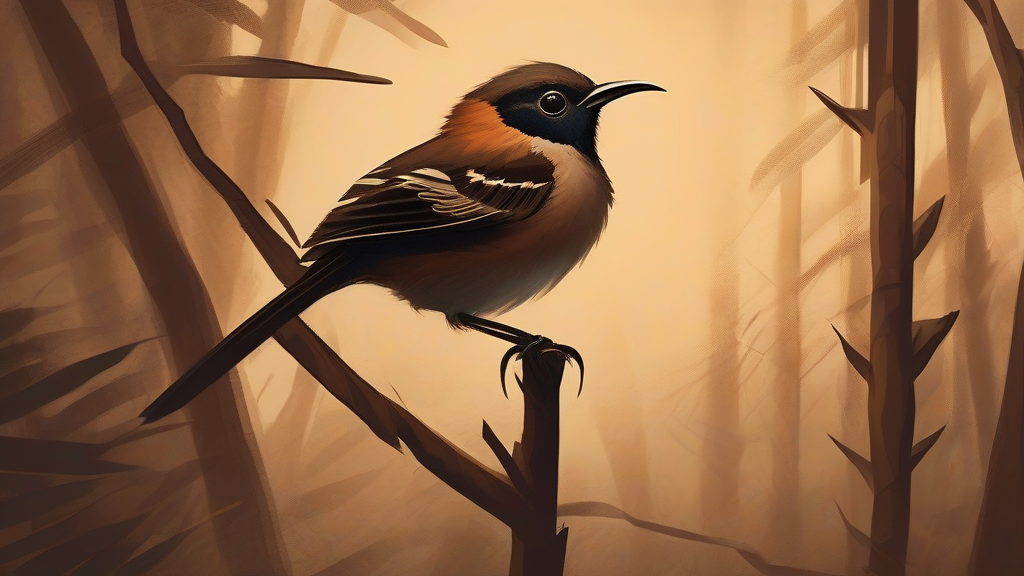
What does antbird mean?
An antbird is a member of Thamnophilidae, a large family of small to medium-sized perching birds found throughout Central and South America, with the greatest diversity in the Amazon basin. Typically drab — gray, brown, or black, often with subtle patterning — antbirds inhabit forest interiors where they forage for insects and other arthropods. Many species are famous for attending columns of army ants, not to eat the ants themselves, but to capture the beetles, crickets, and other creatures fleeing ahead of the swarm. This striking behavior has given the family its common name. Antbirds are of strong interest to ornithologists and birders alike, both for their cooperative mixed-species flocks and for their role as indicators of intact tropical forest habitat.
nounAn antbird is any of numerous small to medium-sized passerine birds of the Neotropical family Thamnophilidae, typically inhabiting forests of Central and South America and often following swarms of army ants to feed on the insects flushed out.
- Any member of the family Thamnophilidae of Neotropical perching birds, many of which habitually follow army-ant swarms.
"The bicolored antbird trailed the army-ant swarm through the understory, snapping up insects flushed from the leaf litter."
"A mixed flock of antbirds and woodcreepers gathered at the edge of the swarm."
"The spotted antbird is one of the most frequently encountered species at ant swarms in lowland rainforest."
Standard pluralization applies; no irregular form exists.
"Several antbirds were visible along the trail at dawn."
Antbirds don't actually eat ants — they shadow marauding columns of army ants and snatch up the terrified insects trying to escape.
Reviewed by Deb Chak, Editor. AI-assisted content curated by RJS Tech Solutions LLP.
Etymology of antbird
The compound 'antbird' arose naturally from English roots: 'bird' derives from Old English 'bridd' (a metathesized form of 'brid'), while 'ant' comes from Middle English 'amete', ultimately from Proto-Germanic *ēmaitijô, meaning 'the biter-off'. The term was coined by naturalists to describe birds observed following army ants, and it parallels other descriptive bird names built on behavior, such as 'flycatcher'.
How antbird is actually used
The name is somewhat misleading: most antbirds do not eat ants themselves but rather prey on other arthropods disturbed by army ants. The word is used chiefly in ornithological and birding contexts.
Easily confused with antbird
An anteater is a mammal that feeds primarily on ants, whereas an antbird is a bird that follows ant swarms to prey on other insects.