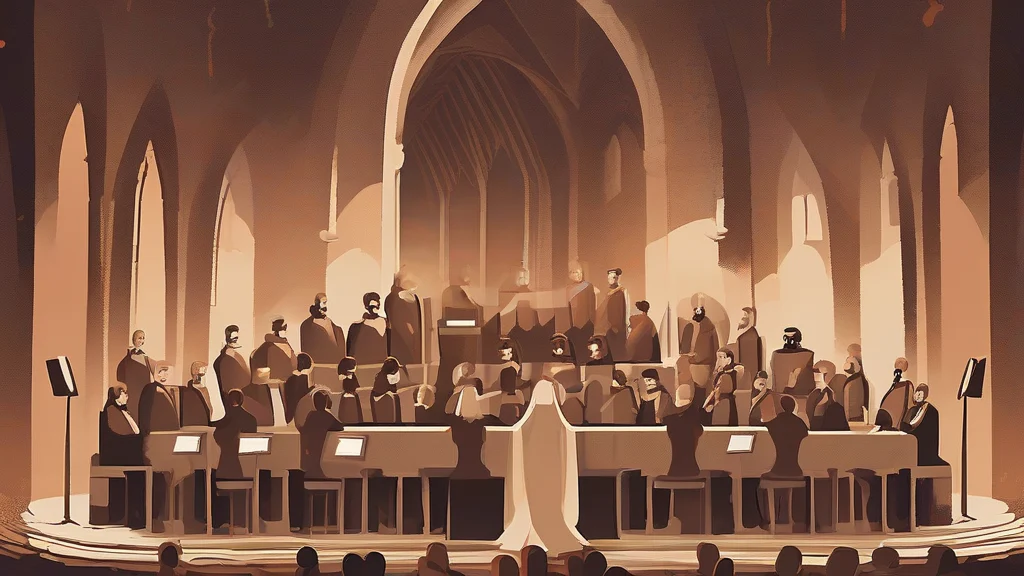
What does antiphony mean?
Antiphony refers to the practice of performing music or chant with two groups answering one another alternately — one side sings a phrase, and the other responds. The term is most closely associated with Western church music, where congregations or monastic choirs have long been divided into two halves to sing psalms and canticles in this responsive manner, but it also applies more broadly to any structured vocal exchange, including musical genres built on call-and-response. Derived from Greek roots meaning 'against' and 'sound,' the word entered English in the early modern period alongside its relative 'antiphon,' a specific responsive chant. Antiphony carries a formal, scholarly register and appears chiefly in discussions of sacred music, medieval worship, and literary works whose structure echoes a dialogue between opposing voices. Its enduring appeal lies in the way it captures the power of sound passed back and forth — a conversation made audible.
nounA style of musical or liturgical performance in which two groups sing or chant alternately in response to one another; more broadly, any alternating exchange of sound or speech between two parties.
- Alternating singing or chanting by two groups in liturgical or musical performance.
- Any alternating vocal exchange or dialogue between two voices or parties.
"The choir's antiphony filled the cathedral as the two halves of the ensemble answered each other across the nave."
"The Gregorian chant was performed in antiphony, with the monks on either side of the altar trading verses."
"The poem reads like an antiphony between doubt and faith, each stanza answering the last."
The plural is rare and generally reserved for referring to multiple distinct instances, styles, or compositions involving antiphonal performance.
"The concert surveyed antiphonies from Venetian polychoral music to contemporary gospel."
When one half of a congregation sings 'Praise the Lord' and the other answers 'For His mercy endures forever,' that call-and-response is antiphony — a practice so old it shaped the very word 'anthem.'
Reviewed by Deb Chak, Editor. AI-assisted content curated by RJS Tech Solutions LLP.
Etymology of antiphony
Antiphony derives from the Greek 'antiphōnos,' combining 'anti-' ('against' or 'in return') with 'phōnē' ('voice' or 'sound'), literally meaning 'sounding in answer.' The term passed through Latin into English in the early 17th century, when interest in ancient and liturgical musical practices was flourishing. It shares its root with 'antiphon,' the name for a responsive chant itself, and more distantly with 'anthem,' which evolved from the same Greek source via Old English 'antefn.' Other descendants of the 'phōnē' root include 'telephone' and 'euphony.'
Related word forms
How antiphony is actually used
Antiphony is a formal, somewhat technical term used mainly in musicology, liturgy, and literary criticism; in everyday conversation, 'call and response' is the more familiar equivalent.
Easily confused with antiphony
An antiphon is a specific short verse or chant sung before or after a psalm, whereas antiphony is the general practice or style of alternate singing between two groups.
An epiphany is a sudden moment of insight or revelation, unrelated in meaning despite the similar ending.