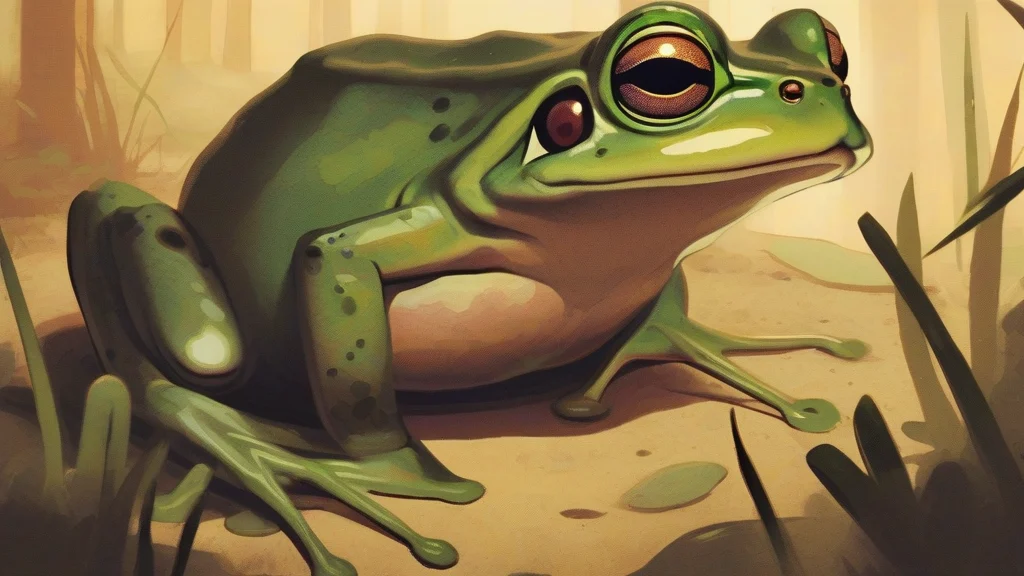
What does anuran mean?
An anuran is a frog or toad — any member of Anura, the largest order of amphibians, whose adults are distinguished by having no tail. The word also functions as an adjective describing anything pertaining to frogs and toads, as in 'anuran species' or 'anuran larvae.' Coined from the Greek elements an- ('without') and oura ('tail'), it reflects the defining anatomical fact that these animals lose the tail they possess as tadpoles when they metamorphose into adults. In practice, anuran belongs to the vocabulary of zoologists, ecologists, and science writers rather than everyday conversation, where 'frog' and 'toad' suffice. Its value lies in precision: because it covers both frogs and toads — which are not formally distinct groups — it names the whole order without ambiguity. For anyone reading field studies, conservation reports, or herpetological literature, 'anuran' is the standard, unambiguous term for this familiar and remarkably diverse group of amphibians.
A frog or toad; any tailless amphibian of the order Anura.
"Chytrid fungus has devastated anuran populations on every continent where they occur."
Used mainly in zoological and ecological writing; 'frog' or 'toad' is preferred in general prose.
Of, relating to, or characteristic of frogs and toads.
"The reserve protects critical anuran breeding habitat along the river floodplain."
Standard regular plural, used when referring to multiple individuals or species collectively.
"Tropical forests support far greater diversity of anurans than temperate regions do."
Frogs are so defined by what they lack that scientists named their entire order after the missing part: 'anuran' literally means 'tailless.'
Reviewed by Deb Chak, Editor. AI-assisted content curated by RJS Tech Solutions LLP.
Etymology of anuran
Anuran derives from the Greek anouros, meaning 'tailless,' formed from the negative prefix an- combined with oura, 'tail.' The term entered scientific Latin as Anura, the formal name of the frog and toad order, and English adopted 'anuran' from this taxonomic usage. Related formations from the same Greek root include 'anurous' (the earlier English adjective form) and anatomical terms such as 'urostyle' and 'uropygium,' both built on oura.
How anuran is actually used
Anuran is a technical term used chiefly in zoology, ecology, and scientific writing; everyday speech simply says 'frog' or 'toad.' It carries no connotation beyond its literal meaning and is register-neutral within formal contexts. The noun and adjective forms share identical spelling.