What does anvil mean?
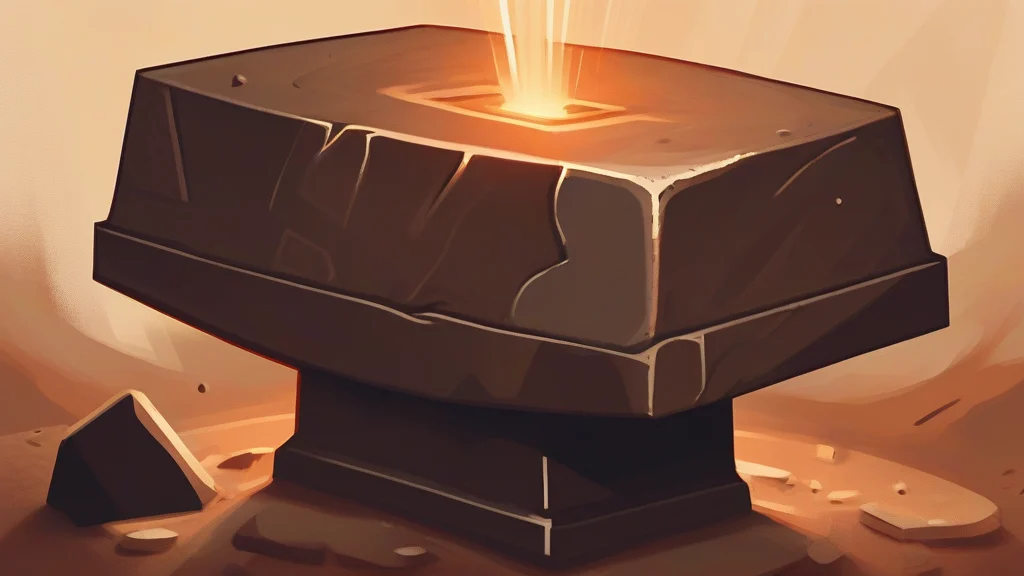
An anvil is a heavy block of iron or steel with a flat working surface, typically mounted on a sturdy base, on which metal—most often heated iron—is shaped by hammering. It is the central tool of the blacksmith's forge, providing a firm, immovable surface against which soft metal can be bent, flattened, and formed. Most anvils feature a pointed projection called a horn, used for curving metal, alongside a flat face for general work. Beyond its literal craft meaning, 'anvil' appears figuratively in phrases such as 'between the hammer and the anvil,' describing someone caught between two opposing pressures. The word also names the incus, one of the three tiny bones of the middle ear, so called because its shape resembles the smith's tool. Evocative of industry, craftsmanship, and endurance, the anvil carries strong connotations of strength and tradition, and it remains a familiar symbol in art, literature, and popular culture.
nounA heavy iron block with a flat top on which metal, especially hot iron, is shaped by hammering.
- A heavy iron or steel block with a flat face and often a pointed horn, used as a surface for shaping metal by hammering.
- Figuratively, anything that withstands pressure or serves as the setting for intense strain or conflict (e.g., 'the anvil of war').
"The blacksmith shaped the glowing horseshoe on his anvil with steady, rhythmic blows."
"The blacksmith hammered the red-hot iron into shape on the anvil."
"The treaty was forged between the hammer of public opinion and the anvil of political necessity."
Regular plural; commonly used when referring to workshops, factories, or collections of tools.
"The old foundry still houses rows of rusted anvils along its walls."
Cartoon anvils famously fall from the sky onto hapless characters — making this humble blacksmith's tool one of the most recognizable objects in animation history.
Reviewed by Deb Chak, Editor. AI-assisted content curated by RJS Tech Solutions LLP.
Etymology of anvil
The word 'anvil' derives from Old English 'anfealt' (also spelled 'anfilt'), which traces back to a Proto-Germanic compound literally meaning something like 'on-felt' or 'struck upon,' combining elements meaning 'on' and 'to strike or beat.' Cognates appear in other Germanic languages, such as Dutch 'aambeeld' and German 'Amboss,' reflecting the shared heritage of blacksmithing cultures across northern Europe. The word has been in continuous use since the earliest stages of English, underscoring how ancient and essential the smith's trade has been.
How anvil is actually used
Primarily a concrete, technical term associated with blacksmithing and metalwork; figurative uses are literary and relatively rare. In anatomy, 'anvil' is also the informal name for the incus, the middle bone of the ear.