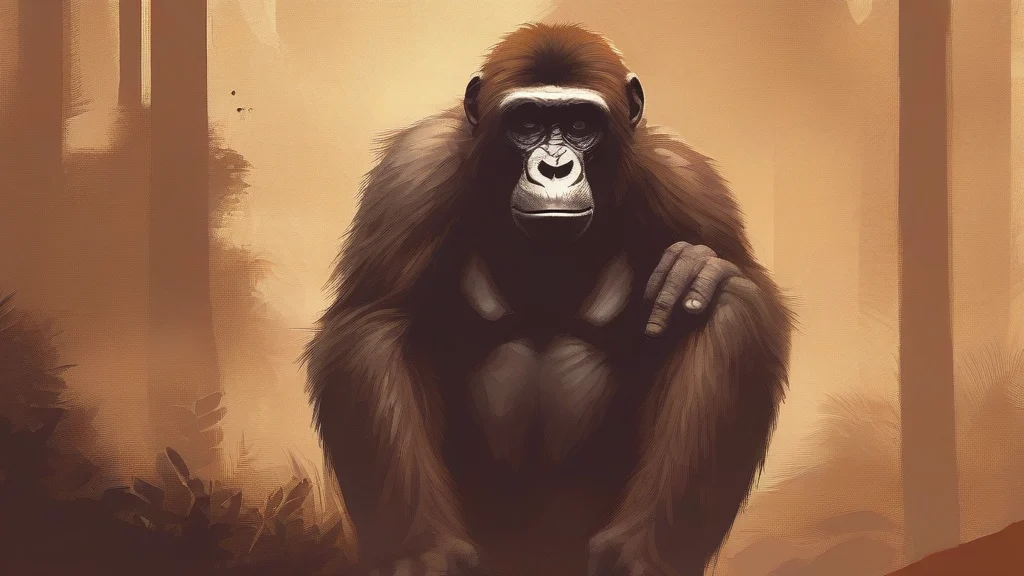
What does ape mean?
An ape is a large primate belonging to the group that includes gorillas, chimpanzees, orangutans, and gibbons — primates distinguished from monkeys chiefly by their lack of a tail, larger body size, and greater cognitive capacity. Humans are themselves classified as great apes, making the word as much about us as about our animal relatives. Beyond its zoological sense, 'ape' also functions as a verb meaning to imitate or mimic, often with a hint of criticism: someone who apes another's mannerisms copies them superficially or slavishly rather than learning genuinely. Informally, an ape can describe an uncouth or clumsy person, though this usage now sounds dated. The word carries rich cultural weight, appearing in idioms like 'go ape,' meaning to erupt in excitement or fury, and in centuries of debate about what separates humans from their closest evolutionary cousins. Few common words bridge science, slang, and self-reflection so compactly.
A large primate lacking a tail, including gorillas, chimpanzees, orangutans, and gibbons; also informally, an uncouth or imitative person.
"Chimpanzees are among the most intelligent of all the great apes."
In formal scientific use, humans are classified as great apes.
To imitate or mimic someone's behaviour, speech, or style, typically in a way regarded as clumsy, slavish, or unthinking.
"He resented being accused of merely aping his mentor's techniques."
Standard plural; used both for multiple animals and figuratively.
"The sanctuary cares for rescued apes from several species."
The phrase 'going ape' has been used since the mid-20th century to describe wild excitement — proof that one animal gave English both a noun and a whole mood.
Reviewed by Deb Chak, Editor. AI-assisted content curated by RJS Tech Solutions LLP.
Etymology of ape
The word 'ape' derives from Old English 'apa', meaning ape or monkey, which in turn traces back to Proto-Germanic '*apōn'. Cognates appear across the Germanic languages, including Old Norse 'api' and German 'Affe'. In older English usage, 'ape' could refer to any monkey as well as to true apes; the modern restriction to tailless primates developed later. The verb sense — to imitate — arose by extension in the sixteenth century from the observed mimicking behaviour of apes.
Related word forms
How ape is actually used
As a verb, 'to ape' often carries a mildly negative connotation, suggesting slavish, unoriginal imitation rather than thoughtful emulation. The informal noun sense describing a person is somewhat dated but still understood. In scientific contexts, 'great ape' refers specifically to the family Hominidae (orangutans, gorillas, chimpanzees, bonobos, and humans), while 'lesser ape' refers to gibbons.
Easily confused with ape
Monkeys typically have tails and belong to a different group of primates, whereas apes are tailless and generally larger and more intelligent.
The idiom 'go ape' means to become wildly excited or angry, which differs from the literal animal sense.