
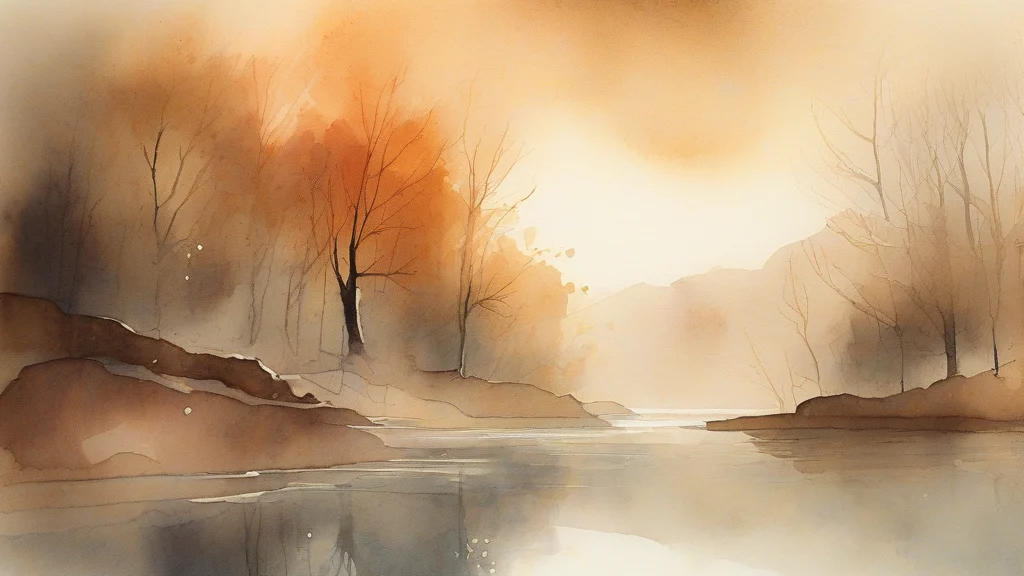
What does aquarelle mean?
An aquarelle is a painting produced with water-soluble pigments, typically applied in thin, transparent washes that allow the white of the paper to shine through and lend the work its characteristic luminosity. The word also denotes the technique itself: a method of painting prized for its subtlety, spontaneity, and difficulty of correction, since mistakes cannot easily be painted over. Borrowed from French, where it derives from the Italian 'acquerello', ultimately from Latin 'aqua' meaning water, the term entered English in the nineteenth century and remains associated with fine-art contexts. It appears most often in gallery catalogues, exhibition reviews, and discussions of artists who favoured the medium, such as the English watercolourists and later Impressionists. Though 'watercolour' is the everyday English word for the same medium, 'aquarelle' adds a note of continental refinement and is useful when distinguishing transparent washes from opaque techniques like gouache.
nounA painting made with water-soluble pigments, especially one executed in a transparent, delicate style; also the technique of such watercolour painting itself.
- A painting executed in transparent watercolour.
- The technique or style of transparent watercolour painting.
"The gallery's autumn exhibition features a luminous aquarelle of the harbour at dawn."
"She spent the afternoon at her desk, building up an aquarelle of the garden in soft washes of green and violet."
"The auction catalogue described lot 42 as an aquarelle on paper, signed and dated by the artist."
Standard plural; used when referring to multiple individual paintings.
"The collector's bequest included twelve aquarelles spanning the artist's entire career."
Borrowed straight from French, 'aquarelle' literally means 'little water' — a fitting name for a medium whose beauty depends on letting water do the painting.
Reviewed by Deb Chak, Editor. AI-assisted content curated by RJS Tech Solutions LLP.
Etymology of aquarelle
Aquarelle was borrowed into English from French in the nineteenth century, though it derives ultimately from the Italian 'acquerello', a diminutive formed on 'acqua' meaning water, which comes from Latin 'aquam'. The diminutive sense — literally 'a little water' — reflects the medium's defining reliance on diluted pigment. It shares this Latin root with words such as aquarium, aquatic, and aqueduct.
How aquarelle is actually used
Aquarelle is a somewhat formal or art-world term, more common in European contexts and auction catalogues than everyday speech. It carries connotations of delicacy, transparency, and refinement. In ordinary English, 'watercolour' is far more common; 'aquarelle' is chosen when precision or elegance is wanted.
Easily confused with aquarelle
Gouache is an opaque water-based paint, whereas aquarelle refers to transparent watercolour work where the white of the paper shows through.
Watercolour is the general English term for the medium, while aquarelle is a more specific, often French-influenced term implying a refined transparent style.