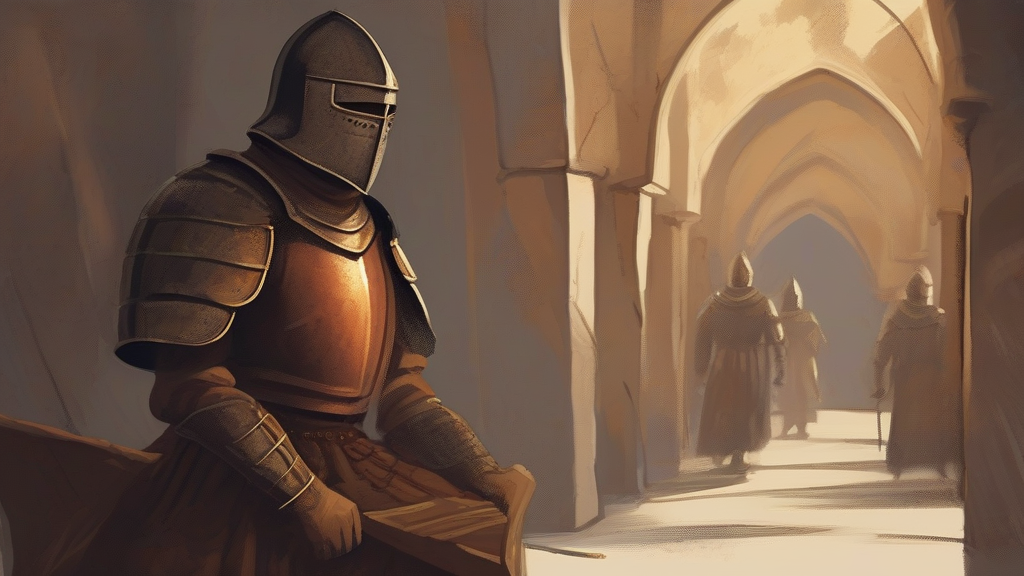
What does armet mean?
An armet is a distinctive type of helmet developed in the fifteenth century, most closely associated with Italian armourers, that completely encloses the wearer's head and face. Unlike open-faced helmets of the same era, such as the sallet, the armet features hinged cheekpieces that wrap around the jaw and fasten at the chin, often combined with a pivoting visor for vision and ventilation. This construction offered exceptional protection while remaining relatively light and closely fitted, making it a favoured choice for knights in battle and tournament alike. The term appears almost exclusively in specialist contexts — museum catalogues, works on arms and armour, historical fiction, and role-playing games — where precision about armour types matters. For readers interested in medieval history, the armet represents the culmination of centuries of refinement in personal protection, a piece of equipment engineered as carefully as any garment tailored for nobility, and it remains one of the most recognizable silhouettes of the age of plate armour.
nounAn armet is a close-fitting helmet of the fifteenth and sixteenth centuries, typically of Italian origin, which fully encloses the head and face and is characterized by hinged cheekpieces that fasten at the chin.
- A form of close-fitting, fully enclosing helmet worn by knights in the fifteenth and sixteenth centuries, especially in Italy.
"The knight's armet, with its visor lowered, left no part of his face exposed to the enemy's lance."
"The museum's collection includes an Italian armet dating from around 1480."
"When the visor of his armet slammed shut, the jouster vanished entirely behind steel."
Standard regular plural; used when referring to multiple examples, as in collections or comparative studies of armour.
"The gallery displayed three armets side by side, each from a different Milanese workshop."
The armet was so precisely fitted to its wearer's head that it was essentially a metal second skin — the closest thing the Middle Ages came to bespoke engineering.
Reviewed by Deb Chak, Editor. AI-assisted content curated by RJS Tech Solutions LLP.
Etymology of armet
The etymology of 'armet' is uncertain, though it entered English in the late medieval period, likely through Old French or directly from Italian usage among armourers. A common suggestion derives it from a diminutive formation related to words for arms or armour, connecting it ultimately to the Latin 'arma' meaning tools or weapons — the same root that gives English 'armor' and 'armament'. Its precise first attestation is debated, but it was established in English by the early modern period as collectors and historians began classifying medieval helmets.
How armet is actually used
The word belongs chiefly to the specialized vocabulary of arms and armour, appearing in museum catalogues, historical scholarship, and fantasy fiction rather than everyday speech. It is a formal, technical term with neutral connotation.
Easily confused with armet
A helmet is any protective head covering in general, whereas an armet is a specific type of fully enclosing medieval helmet with hinged cheekpieces.
A sallet is a contemporary open-faced helmet leaving the lower face exposed, while an armet closes completely over the face.