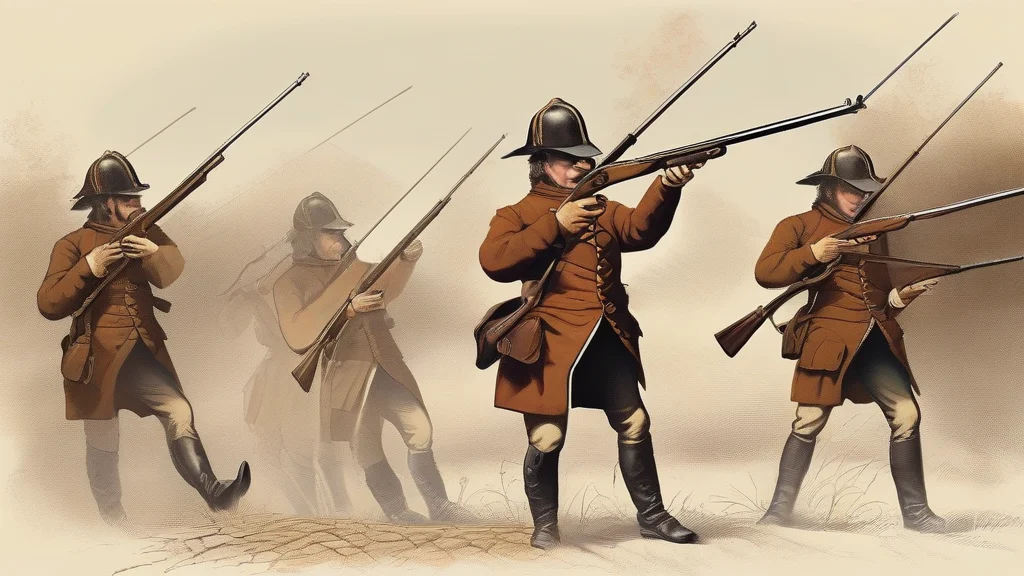
What does arquebus mean?
An arquebus is a portable, muzzle-loading firearm that transformed European warfare in the fifteenth and sixteenth centuries. Fitted with a matchlock mechanism — a slow-burning cord lowered into the priming powder by pulling a trigger or lever — it allowed a single foot soldier to fire a shot without the strength or training required by earlier hand cannons. Its distinctive curved butt, which rested against the shooter's shoulder, is reflected in its name, which likely derives from a term for a 'hooked' gun. Lighter than the later musket, the arquebus was typically fired from a forked rest and proved decisive in battles such as Pavia (1525). Today the word survives mainly in military history and historical fiction, with the carrier of such a weapon known as an arquebusier.
nounA portable muzzle-loading firearm with a matchlock mechanism and a curved stock, used by infantry from the 15th to the 17th centuries.
- A portable muzzle-loading matchlock firearm with a curved butt, used by European infantry from about the mid-15th to the late 16th century.
"The musketeers laid down their arquebuses as the cavalry charged."
"Spanish soldiers armed with arquebuses dominated battlefields in the early 16th century."
"The museum's collection includes a finely preserved arquebus with its original matchlock mechanism."
The standard plural is "arquebuses"; the older form "arquebusses" also occurs in historical texts.
"The garrison mustered fifty arquebuses for the defense of the walls."
The arquebus was the first gun you could actually aim while holding it — and its curved stock gave it a name meaning roughly 'hooked gun.'
Reviewed by Deb Chak, Editor. AI-assisted content curated by RJS Tech Solutions LLP.
Etymology of arquebus
The word "arquebus" entered English in the sixteenth century from French "arquebuse." The French term itself arose through a blending of Germanic and Romance elements: it is generally traced to Middle Dutch or Middle Low German "hakebusse" (literally 'hook-gun,' from the hook used to brace the weapon when firing), reshaped under the influence of Latin "arcus" ('bow') and Italian "archibugio." Related English forms include the variant "harquebus" and "hackbut," borrowed directly from the Dutch-German source.
Related word forms
How arquebus is actually used
"Arquebus" is a historical term used almost exclusively in military history, museums, and historical fiction; it never refers to modern firearms. The variant spelling "harquebus," along with "hackbut," appears in older texts. The soldier who carried one was called an arquebusier.
Easily confused with arquebus
An arquebus is the earlier, lighter matchlock shoulder arm of the 15th–16th centuries, while the musket is a later, heavier firearm that superseded it.