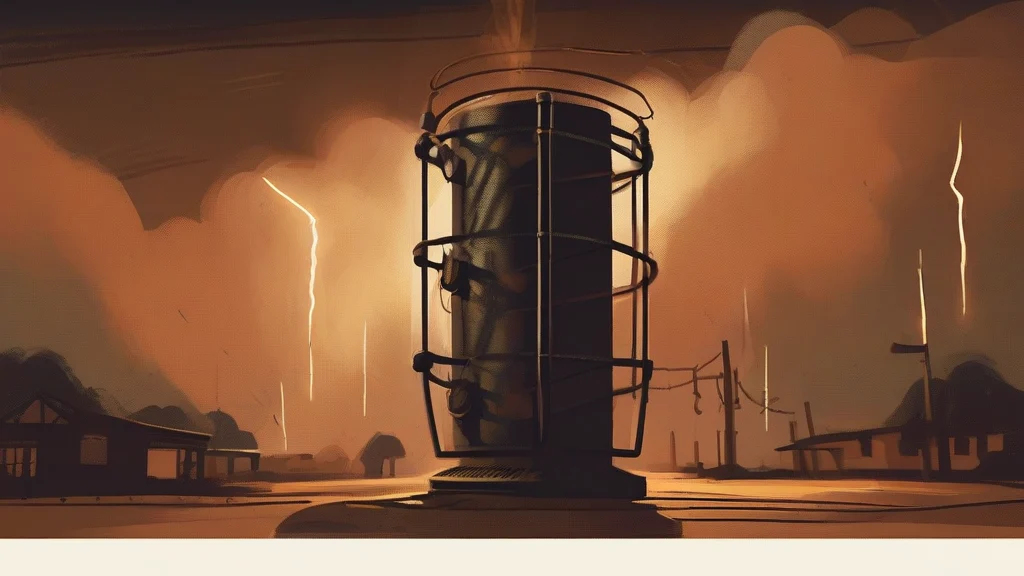
What does arrester mean?
An arrester is a noun denoting a device — or occasionally a person — whose function is to stop, slow, or halt something. The word appears chiefly in technical domains. In aviation, an arrester wire or cable on an aircraft carrier deck catches a landing plane's tail hook and brings it rapidly to rest. In electrical engineering, a lightning arrester (also called a surge arrester) diverts sudden spikes of voltage safely to ground, protecting sensitive equipment from damage. A spark arrester, fitted to engine exhausts and chimneys, traps hot embers before they can escape and start fires. Though these applications differ, they share a common logic: intercepting a force in motion and neutralising it. The term derives from the verb 'to arrest', meaning to seize or stop, which itself traces back through Old French to Latin 'arrestare'. Because it is largely confined to specialist usage, 'arrester' is unfamiliar to many general readers, yet it names components of real practical importance in transport and power systems worldwide.
nounA device or person that stops or halts something; in technical use, a device designed to arrest the motion of a moving object or to stop an unwanted flow, such as a lightning arrester that protects electrical equipment from surges.
- A mechanical device that stops or slows a moving object, such as an arrester wire on an aircraft carrier.
- An electrical device that protects equipment by diverting dangerous voltage surges, such as a lightning arrester.
- A device that prevents sparks or flames from passing, such as a spark arrester on an exhaust pipe.
"The aircraft's tail hook caught the arrester wire, bringing it to a halt within seconds."
"The pilot's tail hook snagged the arrester cable and the jet slammed to a stop on the carrier deck."
"Electricians installed a surge arrester at the panel to shield the home's wiring from lightning strikes."
Standard pluralisation applies; the variant spelling 'arrestors' pluralises identically.
"The substation was equipped with several surge arresters to guard against lightning damage."
An arrester wire can stop a 30-tonne fighter jet from 150 mph to zero in about two seconds — all thanks to a word most people have never heard.
Reviewed by Deb Chak, Editor. AI-assisted content curated by RJS Tech Solutions LLP.
Etymology of arrester
Arrester derives from the verb 'arrest', which entered English from Old French 'arester', itself from Latin 'arrestare' ('to stop'), based on 'ad-' (to) plus 'restare' (to stand still). The agent-noun form 'arrester' arose in English to denote one who or that which arrests, with its technical senses — stopping aircraft, diverting electrical surges, trapping sparks — developing alongside those technologies. Cognates include the verb 'arrest' and related forms such as 'arresting'.
How arrester is actually used
Predominantly a technical term found in engineering, aviation, and electrical contexts; rarely used in everyday conversation. The variant spelling 'arrestor' also appears, but 'arrester' is more standard.
Easily confused with arrester
'Arrestor' is simply a variant spelling of 'arrester' with identical meaning; both are accepted, though 'arrester' is generally preferred.