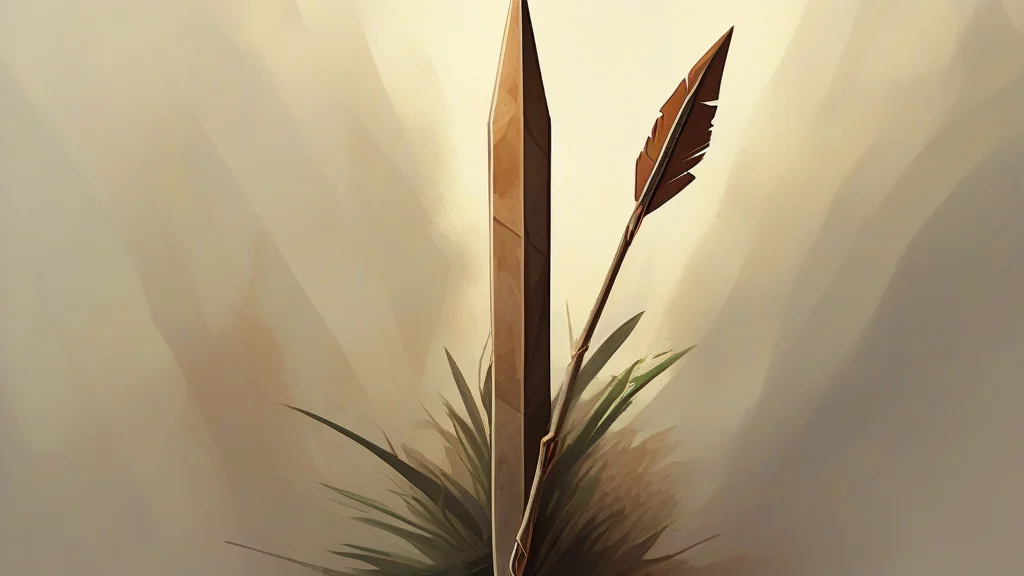
What does arrowhead mean?
An arrowhead is the pointed tip fixed to the front end of an arrow, designed to pierce a target when the arrow is loosed from a bow. Before metalworking spread, arrowheads were painstakingly shaped from flint, chert, obsidian, or bone, and because they survive burial far better than wooden shafts, they are among the most common artifacts unearthed at prehistoric sites — often the chief evidence archaeologists have for ancient hunting practices and trade networks. In modern usage the word also names a group of aquatic plants of the genus Sagittaria, so called because their leaves are shaped like arrowheads. The term carries strong connotations of antiquity, craftsmanship, and survival, appearing frequently in archaeology, history, and popular writing about early human life. Its vivid imagery has also made it a familiar symbol in logos, maps, and directional signage.
The pointed striking tip of an arrow, traditionally made from flint, stone, bone, or metal.
"Each arrowhead had been carefully chipped to a razor-sharp edge."
Most commonly encountered in archaeological, historical, and archery contexts.
Any of various aquatic plants of the genus Sagittaria, having arrow-shaped leaves and starchy edible tubers.
"Arrowhead thrives in the muddy shallows of freshwater ponds and marshes."
Regular plural; used when referring to multiple tips or multiple plants of the genus.
"The dig yielded dozens of arrowheads scattered across the river terrace."
Some flint arrowheads are over 60,000 years old — making them among the oldest surviving human tools ever found.
Reviewed by Deb Chak, Editor. AI-assisted content curated by RJS Tech Solutions LLP.
Etymology of arrowhead
Arrowhead is a straightforward English compound formed from 'arrow' plus 'head', with 'arrow' deriving from Old English 'arwe', likely borrowed from Old Norse 'ör' or related Germanic sources. The compound arose naturally as archers described the striking end of the weapon, and it has been in continuous use since at least the Middle English period. The botanical name comes from the same visual logic: the plant genus Sagittaria was given its English common name 'arrowhead' because its leaves resemble the shape of an arrow's tip.
How arrowhead is actually used
In everyday use, 'arrowhead' most often refers to the projectile point, especially in archaeological and historical contexts. The botanical sense refers to any plant of the genus Sagittaria and is common in gardening and wetland ecology discussions.
Easily confused with arrowhead
An arrowhead is the small piercing tip of an arrow shot from a bow, whereas a harpoon head is a larger barbed point attached to a spear or line used in fishing and whaling.