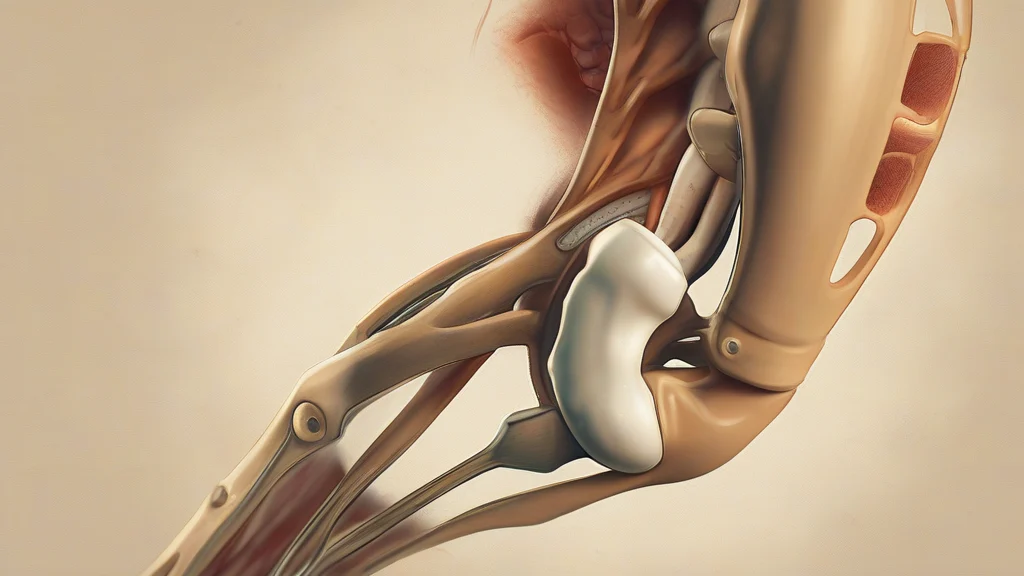
What does arthroplasty mean?
Arthroplasty is the surgical reconstruction or replacement of a damaged or diseased joint, most often performed to relieve pain and restore mobility in patients with severe arthritis, injury, or degenerative joint disease. The term derives from Greek roots meaning 'joint' (arthro-) and 'formation' or 'moulding' (-plasty), reflecting its literal sense of reshaping a joint. In modern practice, arthroplasty usually involves replacing part or all of the joint with an artificial implant — a prosthesis made of metal, ceramic, or plastic — as in total hip arthroplasty or total knee arthroplasty, two of the most commonly performed orthopaedic operations worldwide. The word belongs firmly to medical register; laypeople more often say 'joint replacement.' Related terms such as arthroscopy and arthrodesis are frequently confused with it, though they denote very different procedures. As populations age, arthroplasty has become one of the defining surgeries of modern orthopaedics.
nounA surgical operation to repair or replace a damaged joint, typically by replacing it with an artificial prosthesis, most commonly performed on the hip and knee.
- Surgical reconstruction or replacement of a joint, especially with a prosthetic implant, to relieve pain and restore function.
"After years of arthritis, she finally underwent total knee arthroplasty and was walking again within weeks."
"Surgeons recommended total hip arthroplasty after the X-rays showed severe cartilage loss."
"Advances in materials have greatly extended the lifespan of modern arthroplasty implants."
The plural is standard and is common in clinical writing referring to multiple operations or case series.
"Over 790,000 knee arthroplasties are performed in the United States each year."
The word literally means 'joint shaping' in Greek — and every year, over a million Americans have their hips or knees reshaped by it.
Reviewed by Deb Chak, Editor. AI-assisted content curated by RJS Tech Solutions LLP.
Etymology of arthroplasty
Arthroplasty comes from the Greek 'arthron,' meaning joint, combined with '-plastia,' from 'plassein,' meaning to mould or form. The compound entered English medical vocabulary in the nineteenth century as surgeons developed techniques to reshape stiffened or deformed joints. The same root 'arthro-' underlies many related surgical terms, including arthropathy, arthroscopy, and arthrodesis, while the '-plasty' element appears in procedures such as rhinoplasty and angioplasty.
How arthroplasty is actually used
Strictly a medical term, used almost entirely in clinical, academic, and healthcare-professional contexts rather than everyday conversation. In lay speech, 'joint replacement' is the usual equivalent. It is countable when referring to individual operations (an arthroplasty) but often appears uncountably as the general procedure name.
Easily confused with arthroplasty
Arthroscopy is a minimally invasive diagnostic/procedural technique using a small camera inserted into the joint, whereas arthroplasty is the larger reconstructive or replacement surgery of the joint itself.
Arthrodesis surgically fuses the bones of a joint together to eliminate movement, whereas arthroplasty preserves or restores joint movement.