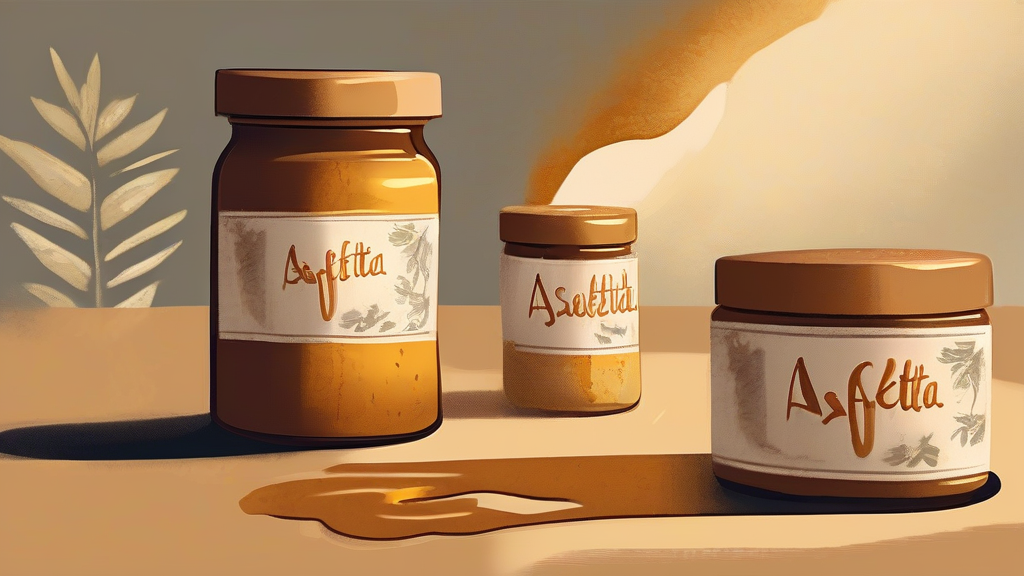
What does asafetida mean?
Asafetida is a strongly aromatic resin harvested from the taproots of Ferula plants, tall fennel-like herbs native to Iran and Central Asia. Raw, it has a notoriously unpleasant, sulfurous smell that earned it nicknames like 'devil's dung,' yet when heated briefly in oil it mellows dramatically, releasing a savory flavor reminiscent of leeks, garlic, and onions. This makes it indispensable in Indian cooking, where it appears — almost always in minute pinches — in dals, curries, and vegetable dishes, and it is prized by cooks who avoid garlic and onions for religious or dietary reasons. Known in Hindi and Urdu as hing, the spice is typically sold as a pale yellow powder often diluted with rice flour and gum arabic. Historically it also had a long career in folk medicine, carried as a protective amulet and prescribed for ailments ranging from digestive complaints to hysteria. The alternative spelling 'asafoetida' preserves its Latin origins.
nounA foul-smelling resin obtained from the roots of certain Asian plants of the genus Ferula, used in Indian cooking in very small quantities for its pungent savory flavor and traditionally in medicine.
- The resinous gum from Ferula plants, sold ground or in lumps, used as a pungent seasoning especially in South Asian cuisine.
- The plant source itself (Ferula assa-foetida and related species), a giant fennel-like herb of Iran and Central Asia.
"A pinch of asafetida sizzled in hot ghee gave the lentil dish its distinctive depth of flavor."
"Tempering cumin and dried chilies in oil with a pinch of asafetida is the classic first step of many Indian dals."
"In Victorian apothecaries, asafetida was carried in small bags around the neck, believed to ward off illness and evil spirits."
Rarely used; asafetida is normally an uncountable mass noun. A plural may appear only when distinguishing different varieties or commercial preparations.
"The shop stocked several asafetidas, ranging in color from dull yellow to deep amber."
Nicknamed 'devil's dung' for its stench, asafetida transforms into a savory onion-garlic flavor the moment it hits hot oil — one of the great magic tricks of the spice world.
Reviewed by Deb Chak, Editor. AI-assisted content curated by RJS Tech Solutions LLP.
Etymology of asafetida
The word derives from medieval Latin 'asa foetida,' meaning literally 'fetid gum' — 'asa' meaning gum or resin and 'foetida' the feminine form of the Latin adjective 'foetidus' (stinking), from the verb 'foetere,' to smell bad. It entered English in the late Middle English period, with the spelling later anglicized to drop the 'o' in American usage. The same Latin root gives English 'fetid' and 'fetor.'
How asafetida is actually used
Usually treated as a mass (uncountable) noun; measured in tiny quantities ('a pinch'). The spelling 'asafoetida' is more traditional and remains common in British English, while 'asafetida' predominates in American English. The Indian name 'hing' is widely used in culinary contexts.
Easily confused with asafetida
Asafoetida is simply an alternative spelling of the same word; both refer to identical substance, with 'asafoetida' retaining the Latin-style 'oe' digraph.
Fenugreek is an unrelated spice made from seeds with a bitter, maple-like flavor, whereas asafetida is a sulfurous resin valued for its onion-garlic taste.