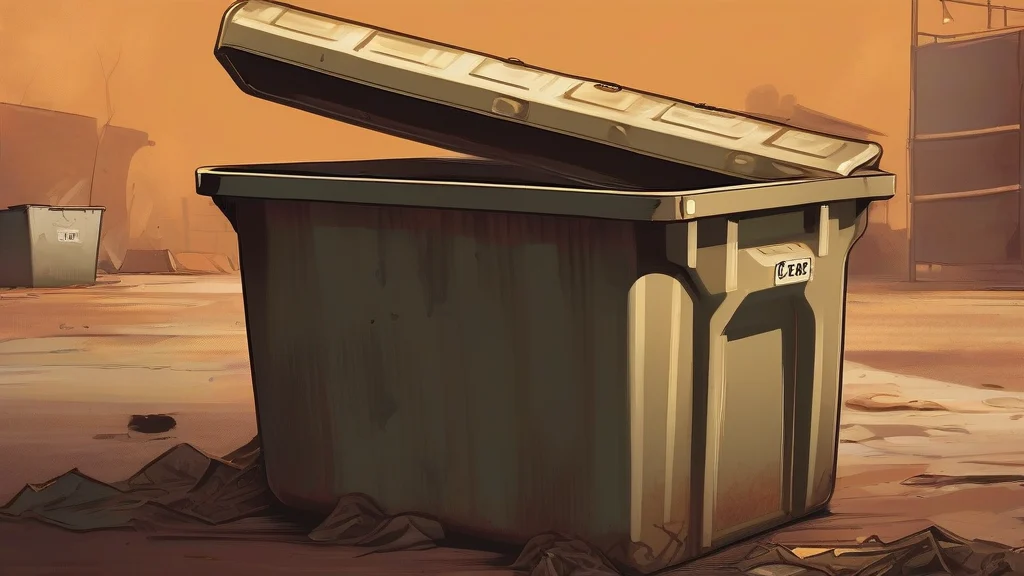
What does ashcan mean?
An ashcan is a container, usually made of metal, used to hold household waste — particularly ashes from coal or wood fires — until it can be collected or discarded. The term arose in American English in the late nineteenth century, when coal-fired heating made ash disposal a daily chore, and it remains chiefly an Americanism, though it sounds somewhat old-fashioned today alongside newer terms like trash can and garbage can. Beyond its literal sense, ashcan has taken on figurative uses: something dismissed as worthless may be said to have been thrown into the ashcan of history. The word is perhaps best known today through the Ashcan School, the early twentieth-century group of American realist painters — including Robert Henri and George Bellows — who depicted ordinary urban life with unvarnished honesty, earning their nickname from their choice of gritty, everyday subject matter.
A metal receptacle for household refuse or ashes, especially one kept outdoors for collection.
"She set the ashcan by the gate on collection day."
Chiefly North American; increasingly replaced in casual speech by 'trash can' or 'garbage can.'
Figuratively, a repository for things rejected, discarded, or deemed worthless.
"The treaty was tossed into the ashcan of failed diplomacy."
Regular plural; used when referring to multiple containers or figuratively to multiple instances.
"Row upon row of ashcans lined the alley behind the tenements."
In the early 1900s, a group of American painters who found beauty in gritty city life were nicknamed the 'Ashcan School' — after the humble garbage can.
Reviewed by Deb Chak, Editor. AI-assisted content curated by RJS Tech Solutions LLP.
Etymology of ashcan
Ashcan is a straightforward English compound formed from 'ash,' from Old English 'asce,' meaning the residue of burned material, and 'can,' from Old English 'canne,' a cylindrical drinking or storage vessel. The compound emerged in American English in the late nineteenth century, when household ashes required regular collection. Its cultural prominence was cemented in the 1910s by the so-called Ashcan School of American painters.
How ashcan is actually used
Primarily American English and somewhat dated; 'trash can' or 'garbage can' is now more common in everyday speech. The word survives prominently in art history through the term 'Ashcan School.'
Easily confused with ashcan
An ash bin is specifically for fireplace ashes, while an ashcan is a more general term for a household garbage can.