What does aspidistra mean?
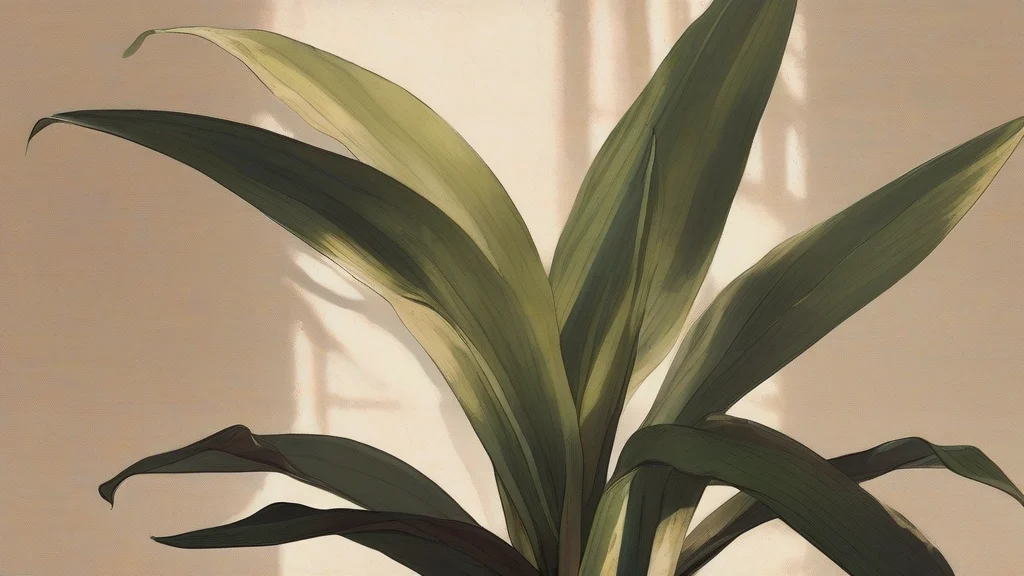
An aspidistra is an evergreen perennial plant native to East Asia, most commonly referring to Aspidistra elatior, known in English as the cast-iron plant. It is prized as a houseplant for its broad, dark-green, strap-like leaves and its extraordinary resilience: it survives deep shade, infrequent watering, temperature fluctuations, and even the polluted air of gas-lit Victorian rooms. Introduced to Europe in the nineteenth century, it became a fixture of respectable British parlours, so closely associated with staid middle-class domesticity that George Orwell used it as a symbol of conventional respectability in his 1936 novel Keep the Aspidistra Flying. Today the name evokes both a genuinely indestructible houseplant and a wry cultural shorthand for old-fashioned propriety. Its botanical genus name derives from the Greek word for shield, a reference to the shape of its stigma.
nounAn East Asian herbaceous plant of the genus Aspidistra, especially Aspidistra elatior, grown as a houseplant for its large, glossy, dark-green leaves and its tolerance of shade, neglect, and poor conditions.
- Any plant of the genus Aspidistra, particularly Aspidistra elatior (the cast-iron plant), cultivated as a hardy evergreen houseplant.
"The dim corner of the Victorian parlour was brightened by a flourishing aspidistra."
"Even in the darkest hallway, the aspidistra kept its leaves glossy and green."
"She watered the aspidistra once a month at most, yet it thrived for decades."
Standard pluralization by adding -s; the word takes normal singular agreement.
"Rows of aspidistras lined the hotel lobby."
The aspidistra was so famously unkillable that George Orwell wrote an entire novel — Keep the Aspidistra Flying — about the shame of owning one.
Reviewed by Deb Chak, Editor. AI-assisted content curated by RJS Tech Solutions LLP.
Etymology of aspidistra
Aspidistra comes from modern Latin, coined as a botanical genus name in the early nineteenth century, ultimately from the Greek 'aspis' meaning shield — an allusion to the shield-like shape of the flower's stigma. The same Greek root gives English the word 'asp', the name of a venomous snake, and underlies related botanical coinages such as 'aspidium'. The plant itself reached European cultivation from China and Japan during the 1800s, and its popular name spread alongside its reputation for toughness.
How aspidistra is actually used
The word carries strong associations with middle-class domestic respectability in late 19th- and early 20th-century Britain, where the aspidistra was ubiquitous in parlour windows — sometimes affectionately, sometimes satirically, as in Orwell's Keep the Aspidistra Flying (1936). The common name 'cast-iron plant' reflects its legendary tolerance of low light, irregular watering, gas fumes, and general neglect.