What does assemblage mean?
An assemblage is a collection of people or things gathered into one place or one whole. The word can describe almost any kind of accumulation — a jumble of seashells on a windowsill, a crowd at a rally, or a set of documents pieced together by a historian — and it typically appears in the phrase 'an assemblage of'. In the art world, however, assemblage has a precise technical meaning: a sculptural work created by joining found or everyday objects into a unified composition, a practice associated with artists such as Picasso and Duchamp and flourishing as a named movement in the mid-twentieth century. The word connotes diversity within unity; whatever it describes is made up of distinct components rather than being naturally uniform. Borrowed from French, where it derives from a verb meaning 'to assemble,' assemblage remains a versatile term for anything formed by bringing separate pieces together.
A collection or gathering of people or things brought together into one place or whole.
"The auction featured a remarkable assemblage of vintage automobiles."
Almost always used with the preposition 'of'; plural is 'assemblages'.
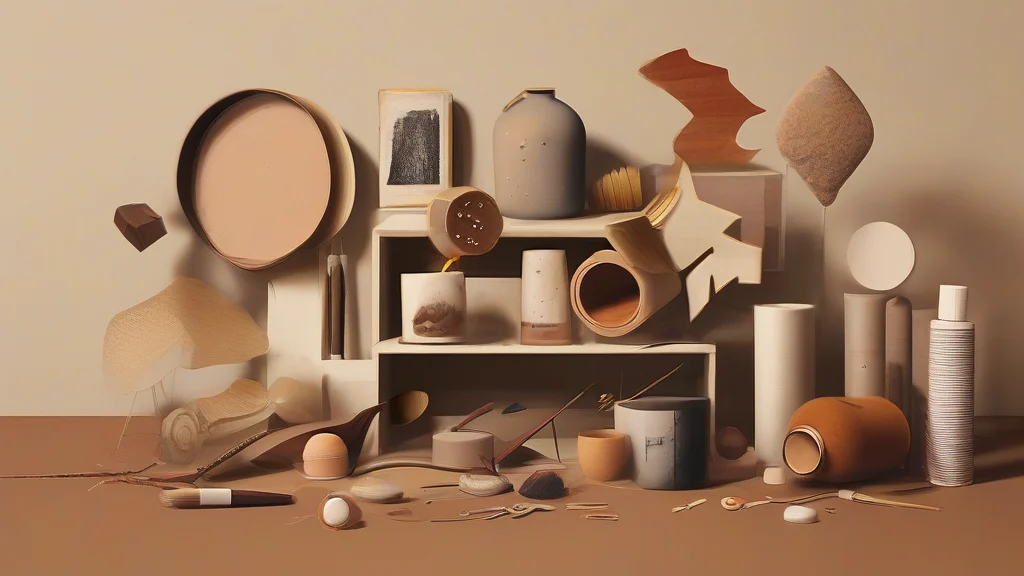
A work of art made by assembling miscellaneous, often found, objects into a three-dimensional form.
"Her assemblage of driftwood, wire, and bottle caps won first prize at the exhibition."
Standard regular plural; used both for multiple collections and multiple artworks of this type.
"The gallery displayed several assemblages constructed entirely from salvaged materials."
The word 'assemblage' was borrowed wholesale from French in the 1600s — and artists later turned it into a movement, gluing broken chairs, ticket stubs, and scrap metal into museum-worthy masterpieces.
Reviewed by Deb Chak, Editor. AI-assisted content curated by RJS Tech Solutions LLP.
Etymology of assemblage
'Assemblage' entered English from French in the seventeenth century, derived from the French verb assembler, meaning to gather or bring together. That verb traces back through Old French to the Vulgar Latin *assimulare, from Latin simul, meaning 'at the same time' or 'together.' The word thus shares deep roots with English relatives including 'assemble,' 'assembly,' and the borrowing 'ensemble,' all pointing back to the same Latin idea of things coming together.
How assemblage is actually used
'Assemblage' carries a slightly formal or literary register when describing collections, but is standard terminology in art criticism, where it names both a technique and a mid-20th-century artistic movement. It usually appears with the preposition 'of'.
Easily confused with assemblage
An assembly typically refers to the act of gathering or a convened group of people (often formal, such as a legislative body), while an assemblage refers to the resulting collection of things or people, and in art to a constructed work.
An ensemble is a coordinated group working as a unit, such as musicians or actors, whereas an assemblage emphasizes the collected objects themselves rather than coordinated action.