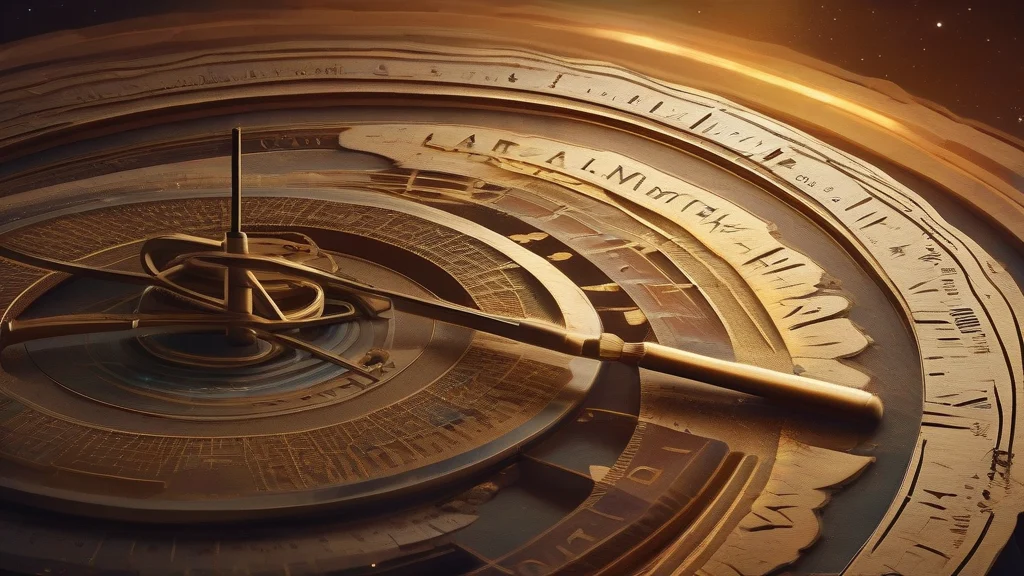
What does astrolabe mean?
An astrolabe is an intricate astronomical instrument, usually made of engraved brass, that was used for well over a millennium to observe and compute the positions of celestial bodies. Its flat, disc-like face represented the heavens above the observer: a rotatable pointer called an alidade allowed users to sight a star or the Sun, read its altitude on the graduated rim, and then work out the time of day or night, the season, or their latitude at sea. Astrolabes also served astrological purposes, such as casting horoscopes. Originating in the Hellenistic world and greatly refined by Islamic scholars, they spread through medieval Europe as prized objects of learning and craftsmanship. Largely superseded by more accurate instruments like the sextant, the astrolabe survives today as a symbol of pre-modern science, appearing frequently in museums, histories of astronomy, and discussions of navigation.
nounAn ancient astronomical instrument, typically a brass disc with a rotating graduated arm (the alidade), used to measure the altitudes of celestial bodies and to solve problems of timekeeping, navigation, and astrology.
- A historical astronomical instrument consisting of a graduated disc with a rotating sighting rule, used to determine the positions and altitudes of stars and the Sun, and thereby to tell time, find latitude, and cast horoscopes.
"The mariner raised his astrolabe toward Polaris to fix his latitude."
"The museum's collection includes a beautifully engraved Islamic astrolabe from the tenth century."
"Using an astrolabe, medieval astronomers could calculate the time of night by measuring the altitude of a known star."
Standard plural, pronounced /ˈæstrəleɪbz/. Surviving instruments are often referred to collectively as 'astrolabes' in museum collections.
"Several medieval astrolabes are displayed in the British Museum."
For over a thousand years, sailors and astronomers carried a pocket-sized brass model of the sky — the smartphone of the medieval world.
Reviewed by Deb Chak, Editor. AI-assisted content curated by RJS Tech Solutions LLP.
Etymology of astrolabe
The word astrolabe comes from Middle French astrolabe and Latin astrolabium, which derive ultimately from Greek astrolabon, meaning 'instrument for taking the altitude of the stars' — formed from astēr ('star') and lambanein ('to take'), so literally a 'star-taker'. It shares its Greek root with related terms such as astronomy and astrology. The instrument itself was known in the Hellenistic world and was transmitted to the Islamic world and later to medieval Europe.
How astrolabe is actually used
The word is chiefly encountered in historical, scientific, or museological contexts, as astrolabes ceased to be practical instruments after the development of the sextant. It carries connotations of antiquity, scholarship, and craftsmanship. The plural is usually 'astrolabes'.
Easily confused with astrolabe
A sextant is a later navigational instrument using mirrors and a graduated arc, whereas an astrolabe is an older disc-shaped instrument used for measuring celestial altitudes and telling time.