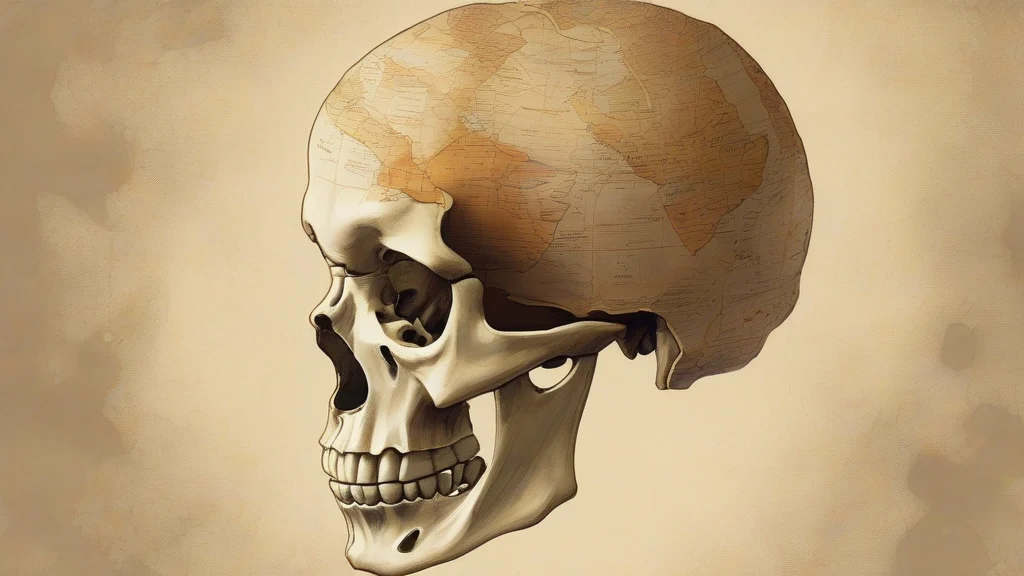
What does atlas mean?
An atlas is a bound collection of maps, typically presenting the geography of the world or of a particular region through political, physical, and thematic mapping. The word most commonly denotes these reference volumes, ranging from pocket road atlases to comprehensive world atlases used in schools, libraries, and homes. The name comes from Atlas, the Titan of Greek mythology condemned to hold up the sky; early collections of maps were published under his image and title, and the association stuck. Beyond cartography, 'atlas' has a specialized anatomical meaning: it names the first cervical vertebra of the neck, which supports the skull — a fitting echo of the mythological burden-bearing. In architecture, an atlas can also be a sculpted male figure serving as a supporting column. The word carries connotations of knowledge, exploration, and orientation, and remains a familiar and evocative term for any authoritative compilation of maps.
A book containing a collection of maps, often with supplementary geographic information.
"The library's antique atlas showed empires that no longer exist."
Most frequently used in compounds such as 'world atlas' or 'road atlas'.
The first cervical vertebra, which articulates with the skull and allows the head to nod.
"The fracture involved the atlas at the top of the spinal column."
Technical anatomical usage, named for the Titan who carried the weight of the heavens.
In classical architecture, a sculpted male figure used as a column to support a structure.
"The portico was supported by carved atlantes instead of plain pillars."
Rare and specialized; the plural in this architectural sense is traditionally 'atlantes'.
The standard plural follows the regular -es pattern. For the architectural sense, the traditional plural is 'atlantes', though 'atlases' is sometimes seen.
"The shop sells atlases covering every continent."
The book of maps got its name from a Titan: early map collections were titled after Atlas, the figure who held up the heavens on his shoulders.
Reviewed by Deb Chak, Editor. AI-assisted content curated by RJS Tech Solutions LLP.
Etymology of atlas
The word derives from Atlas, the Titan of Greek mythology who bore the heavens on his shoulders; the Greek name itself may relate to the verb 'to carry, bear'. It entered English via Latin in the late Middle Ages as a proper noun. Its modern use for a book of maps arose in the sixteenth century, when geographers such as Gerardus Mercator titled their map collections with images of the Titan, fixing the association between Atlas and cartography. Related English words from the same mythological root include Atlantic, Atlantis, and Atlantean.
How atlas is actually used
As a common noun, 'atlas' refers chiefly to books of maps and is standard register. The anatomical sense is technical, used mainly in medical contexts. The capitalized form 'Atlas' refers to the Titan of Greek mythology.
Easily confused with atlas
An atlas is a collection of maps, while an almanac is an annual reference book of facts, dates, statistics, and forecasts.