
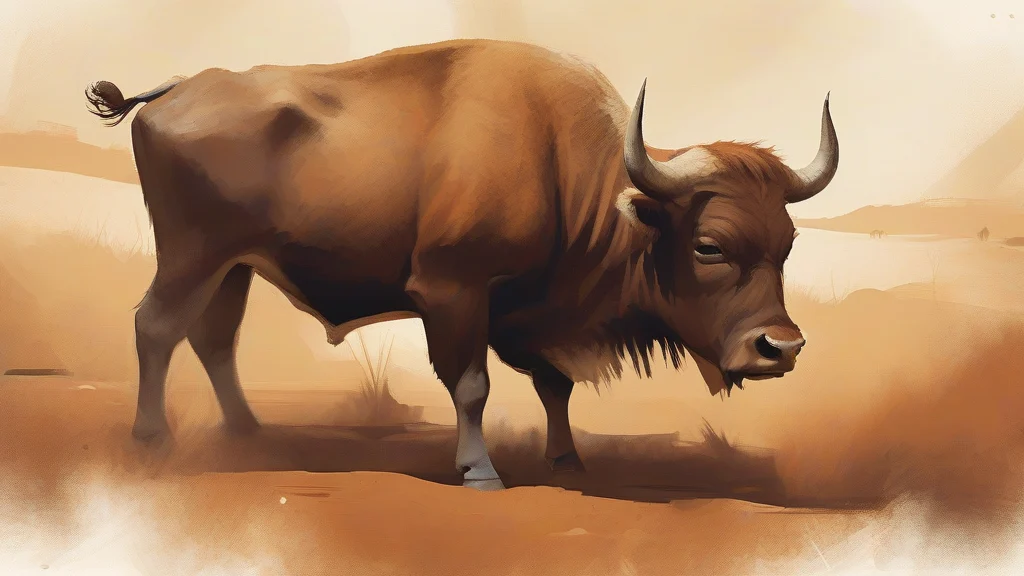
What does aurochs mean?
An aurochs is an extinct species of large wild ox, Bos primigenius, that once ranged widely across Europe, Asia, and North Africa. Standing up to around six feet at the shoulder, it was among the most imposing land mammals of its era and is now recognised as the wild ancestor of all modern domestic cattle. Aurochs appear frequently in prehistoric cave art, notably at Lascaux, testifying to their cultural significance for early humans. Overhunting and habitat loss gradually reduced their range; the last known aurochs, a cow, died in Poland's Jaktorów Forest in 1627. The word functions as a noun whose plural is identical to its singular. Today the term surfaces mainly in zoology, archaeology, and conservation literature, including discussions of 'back-breeding' programmes that attempt to recreate aurochs-like cattle. Knowing the word connects readers to deep history: every cow grazing a pasture descends from this vanished giant.
nounAn aurochs is an extinct wild ox (Bos primigenius) that once roamed Europe, Asia, and North Africa, and from which modern domestic cattle are descended. The last confirmed individual died in Poland in 1627.
- An extinct large wild ox (Bos primigenius) that was the ancestor of domestic cattle, formerly native to Europe, Asia, and North Africa and surviving until 1627.
"Cave paintings at Lascaux show prehistoric hunters pursuing the mighty aurochs across Ice Age landscapes."
"Prehistoric cave artists across Europe immortalised the aurochs in vivid ochre and charcoal."
"Geneticists have attempted to back-breed hardy cattle strains that approximate the ancient aurochs in build and temperament."
The plural is identical to the singular (an invariable noun), so number must be inferred from context or surrounding modifiers.
"Excavations uncovered remains suggesting a herd of aurochs had gathered near the riverbank."
The last aurochs died in 1627 — meaning this colossal wild ancestor of every cow on Earth went extinct just decades after Shakespeare wrote his final play.
Reviewed by Deb Chak, Editor. AI-assisted content curated by RJS Tech Solutions LLP.
Etymology of aurochs
The word 'aurochs' comes from German, where 'Aurochs' (also historically spelled 'Auerochse') combines 'aur' or 'auer', related to an old Germanic word for wild ox or primeval cattle, with 'Ochs', meaning ox. Germanic cognates include Old High German 'ūrohsō'. The term entered English in the late eighteenth century through natural-history writing describing European megafauna.
How aurochs is actually used
The word is formal and largely encountered in zoological, archaeological, and historical contexts. The plural is 'aurochs' (unchanged), which can cause ambiguity; context usually clarifies whether one or several animals is meant. It is sometimes used loosely for any large wild cattle, but careful writers reserve it for Bos primigenius.
Easily confused with aurochs
The aurochs was a wild species of true cattle (Bos primigenius, ancestor of domestic cows), whereas bison are a distinct genus with a humped shoulder and massive head.