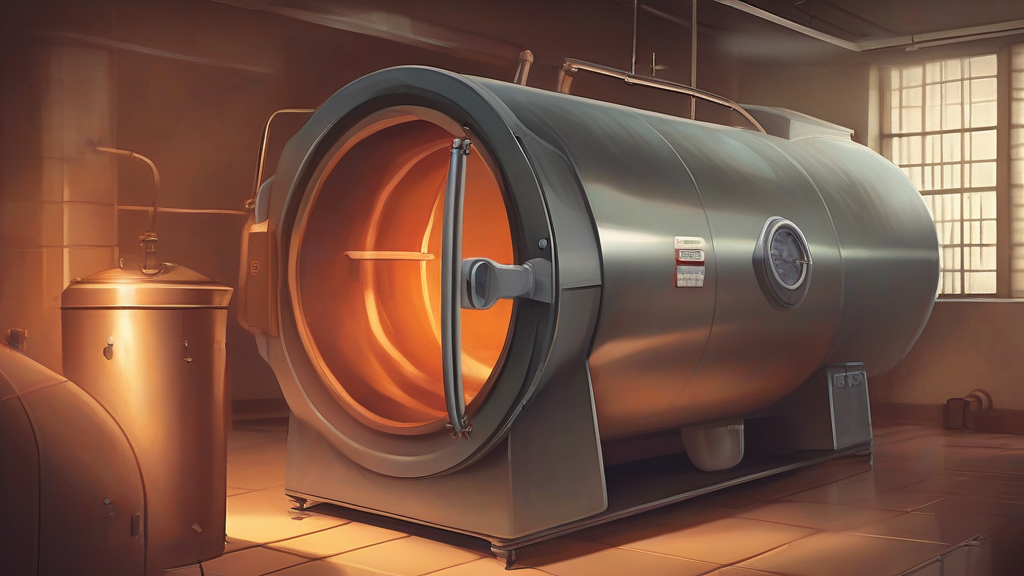
What does autoclave mean?
An autoclave is a robust, sealed vessel designed to hold contents under high-pressure steam at temperatures above the boiling point of water, most famously for sterilizing surgical, dental, and laboratory instruments. Because pressurized steam reaches around 121 °C or higher, it destroys bacteria, viruses, fungi, and resilient spores that ordinary boiling cannot reliably kill, which has made the autoclave indispensable in medicine, microbiology, tattoo studios, and food processing since the late nineteenth century. In industry, larger autoclaves serve very different purposes: they cure aerospace composites, vulcanize rubber, and grow synthetic crystals. The word can also act as a verb — technicians say instruments are 'autoclaved' after use — and derives from Greek 'auto-' (self) and Latin 'clavis' (key), reflecting how the device's own internal pressure locks its lid. It carries a clinical, technical connotation and appears almost exclusively in professional contexts.
A sealed chamber in which items are subjected to high-pressure saturated steam (or, industrially, other pressurized conditions) for sterilization or processing.
"Every scalpel and forceps in the operating theatre passes through the autoclave before reuse."
In medical and laboratory contexts this is the dominant sense; in engineering it may refer more broadly to any heated pressure vessel.
To sterilize or treat something in an autoclave.
"The lab technician autoclaves all media before inoculation."
Regular plural; common when referring to facilities with multiple units, e.g. hospital central sterile services departments.
"The new laboratory is equipped with three floor-standing autoclaves."
The word 'autoclave' literally means 'self-locking' — from Greek 'auto' and Latin 'clavis' (key) — because the device's own pressure seals its door shut.
Reviewed by Deb Chak, Editor. AI-assisted content curated by RJS Tech Solutions LLP.
Etymology of autoclave
The word 'autoclave' entered English from French in the nineteenth century, combining the Greek prefix 'auto-' (self) with the Latin 'clavis' meaning key or lock, so the term literally suggests a vessel that closes itself — early designs were sealed by their own internal pressure rather than by external fasteners. The same Latin root gives us 'clavicle' and 'enclave', while the Greek element appears in words like 'autograph' and 'autonomy'. Its modern association with steam sterilization dates to the pioneering work of Charles Chamberland, working in Pasteur's laboratory, in the 1880s.
Related word forms
How autoclave is actually used
As a verb ('to autoclave'), it is standard technical usage in medical and laboratory settings but rare elsewhere.
Easily confused with autoclave
'Clave' refers either to a pair of wooden percussion sticks or is a past form of 'cleave', while 'autoclave' is a pressurized vessel used for sterilization.