What does avocado mean?
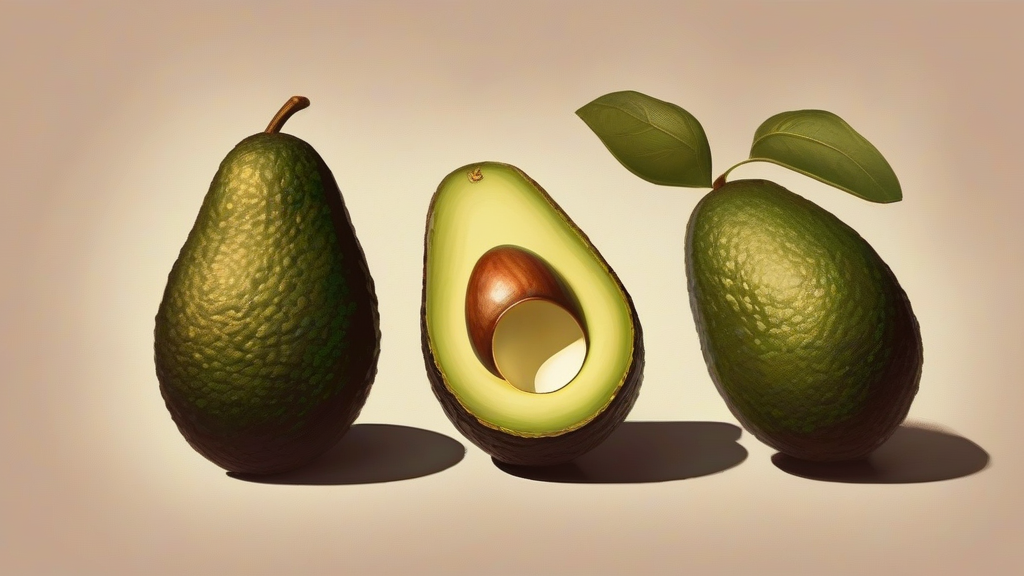
An avocado is the rich, creamy fruit of Persea americana, a tree native to Mexico and Central America. Roughly pear- or egg-shaped, it has tough skin that ranges from green to nearly black when ripe, and soft yellow-green flesh encasing one large central stone. Unlike most fruits, the avocado is high in oil rather than sugar, giving it a smooth, buttery texture that has made it central to dishes such as guacamole, salads, sushi rolls, and the popular avocado toast. The word entered English in the seventeenth century by way of the Spanish 'aguacate', itself borrowed from the Nahuatl term for the fruit; through folk etymology it was reshaped to resemble 'avocate', an older form of 'advocate', which explains its otherwise puzzling spelling. The tree is cultivated widely across subtropical regions, and the fruit's reputation as a healthful source of monounsaturated fats has driven enormous growth in global demand since the late twentieth century.
nounA large, oval fruit with leathery dark-green or purple skin and smooth, buttery pale-green flesh surrounding a single large seed; the tree (Persea americana) that bears it.
- The edible fruit of Persea americana, eaten raw for its creamy green flesh.
- The tropical American evergreen tree that produces this fruit.
"She mashed the ripe avocado with lime juice and salt to make guacamole."
"He spread mashed avocado on sourdough and topped it with a poached egg."
"Avocado trees thrive in mild coastal climates and can take several years to bear fruit."
'Avocados' is the standard plural; the variant 'avocadoes' appears occasionally but is less common.
"The market stall was piled high with ripe avocados."
The word 'avocado' comes from an Aztec term that literally meant 'testicle' — and English speakers in the 17th century mistakenly reshaped it to look like 'advocate'.
Reviewed by Deb Chak, Editor. AI-assisted content curated by RJS Tech Solutions LLP.
Etymology of avocado
The avocado derives its name ultimately from the Nahuatl (Aztec) word 'āhuacatl', which named both the fruit and the testicle — likely a reference to the fruit's shape. The Spanish borrowed it as 'aguacate', and when the fruit reached English speakers in the early seventeenth century, they refashioned the unfamiliar word as 'avocado' under the influence of 'avocate', then a variant of 'advocate'. A related borrowing, 'guacamole', preserves the compound Nahuatl form 'āhuacamolli', meaning avocado sauce.
How avocado is actually used
Informal to neutral register; common in culinary contexts. In British English, 'avocado pear' was formerly a common name, now largely shortened to just 'avocado'. The plural may be 'avocados' or, less commonly, 'avocadoes'; 'avocados' predominates.