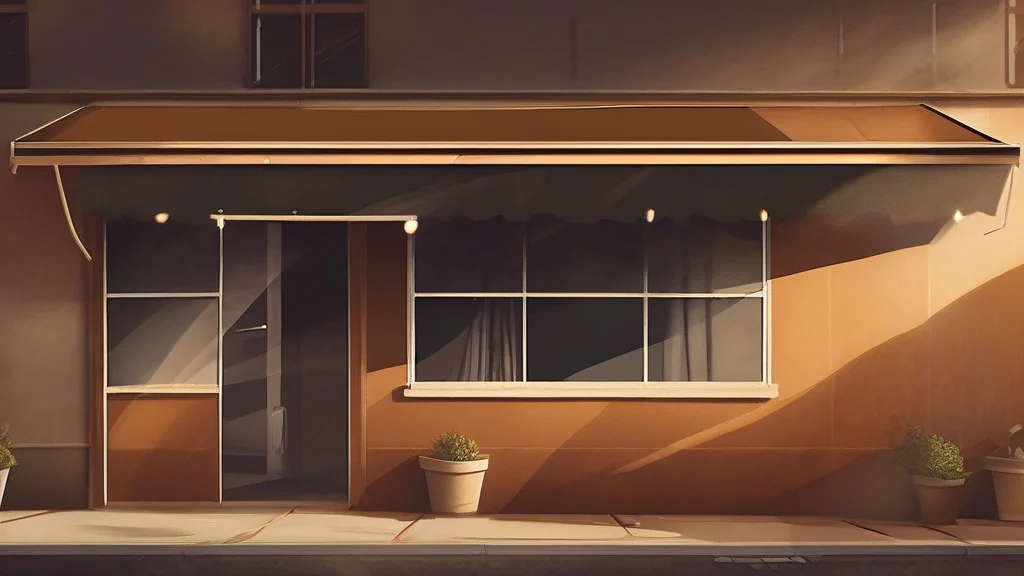
What does awning mean?
An awning is a covering made of canvas, fabric, metal, or another weather-resistant material, stretched across a frame and attached to the outside of a building — or sometimes to a caravan or boat — to shield a window, door, patio, or storefront from sun and rain. Awnings range from simple fixed sheets to elaborate motorized, retractable systems that can be extended or folded away at will. They are a familiar feature of cafés, shops, homes, and markets, lending both practical shelter and visual character; striped canvas awnings over pavement tables are an iconic image of street life in many cities. The word entered English in the early seventeenth century, though its deeper origins remain uncertain, which gives this unassuming household word a small linguistic mystery of its own. Practical and concrete rather than figurative, 'awning' belongs firmly to everyday architectural and commercial vocabulary.
nounA sheet of fabric or other material stretched on a frame, attached to the exterior wall of a building or to a vehicle, to provide shelter from sun or rain, especially over a window, door, or storefront.
- A fabric or material cover stretched over a frame projecting from a building or vehicle, providing shade or shelter from rain.
"The café's striped awning shaded the sidewalk tables from the afternoon sun."
"We sat under the striped awning outside the bistro while a light rain passed."
"The shopkeeper rolled out the canvas awning each morning before opening."
Standard regular plural, used when referring to multiple such covers, e.g. along a row of shops.
"A row of faded green awnings lined the high street."
Nobody knows exactly where 'awning' came from — it appears in English in the early 1600s with no certain ancestor in any language.
Reviewed by Deb Chak, Editor. AI-assisted content curated by RJS Tech Solutions LLP.
Etymology of awning
First attested in English in the early seventeenth century (c. 1620s), the origin of 'awning' is genuinely uncertain. Proposed sources include words in languages encountered through trade and travel of the period, but none has been established with confidence, so dictionaries typically label the etymology obscure. It has always been used as a noun denoting a protective overhead covering, with its modern sense fully formed from the earliest records.
How awning is actually used
A common everyday word with no strong register associations. In American English, 'awning' often refers specifically to retractable or window-mounted fixtures; in British English it is frequently associated with shopfronts and cafés. The plural 'awnings' is standard.
Easily confused with awning
An awning is typically fixed to and projecting from a wall or vehicle, while a canopy is freestanding or hung overhead and not necessarily wall-mounted.
A marquee is a large tent-like structure for events, whereas an awning is a smaller, permanent or semi-permanent fixture over a window or doorway.