What does azulejo mean?
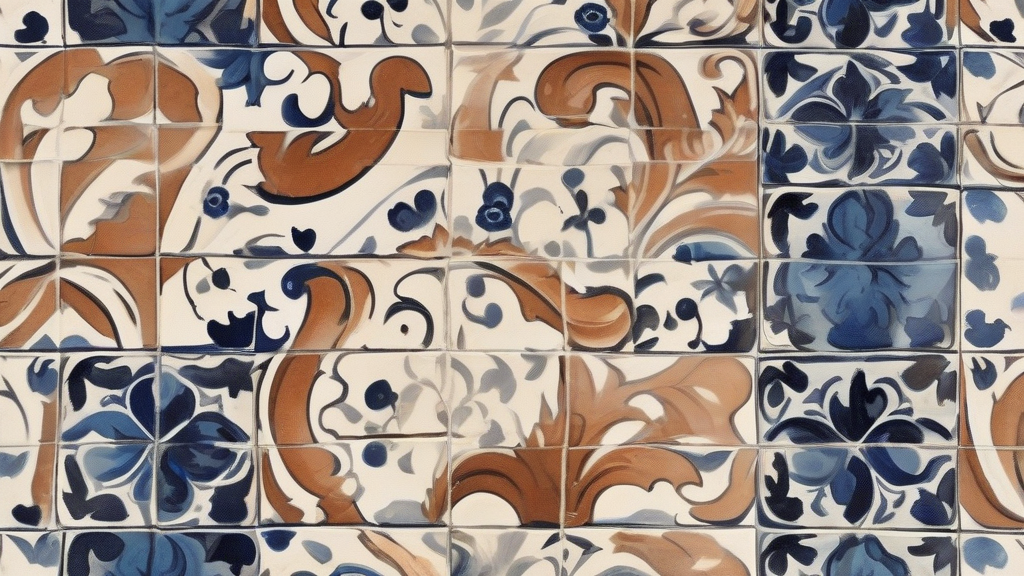
An azulejo is a glazed ceramic tile used extensively to decorate the interiors and exteriors of buildings, most famously in Portugal but also throughout Spain and former Portuguese territories such as Brazil. While many people picture them as blue-and-white, azulejos appear in a wide range of colors and patterns, ranging from simple geometric designs to elaborate pictorial scenes covering whole walls. Introduced to the Iberian Peninsula under Moorish influence, the tradition flourished from the sixteenth century onward and remains a living craft today, adorning churches, palaces, train stations, and ordinary house façades. In English, the word functions as a borrowed term, appearing chiefly in contexts of architecture, art history, and travel writing. Because azulejos almost always occur in quantity, writers tend to use the plural form, and the tiles have become an emblematic symbol of Portuguese cultural identity.
nounA glazed ceramic tile, typically blue-and-white, used to decorate walls and buildings, especially in Portugal and Spain.
- A decorative glazed ceramic tile, often blue and white, characteristic of Portuguese and Spanish architecture.
"The façade of the old church was covered entirely in azulejos."
"The metro stations of Lisbon are famous for their sweeping azulejo murals."
"She collected a single antique azulejo as a souvenir of her trip to Porto."
This is the standard plural in English as well as in Portuguese and Spanish, and it is the more frequently seen form in English-language texts since decorative tiling normally involves multiple pieces.
"The café's interior was a riot of colorful azulejos imported from Lisbon."
Portugal is so devoted to the azulejo that an entire museum in Lisbon—the National Azulejo Museum—is dedicated to nothing but these tiles.
Reviewed by Deb Chak, Editor. AI-assisted content curated by RJS Tech Solutions LLP.
Etymology of azulejo
The word azulejo comes from Portuguese and Spanish, ultimately deriving from the Arabic article plus noun construction 'al-zulayj', meaning a polished or glazed little stone or tile, which itself traces back through Arabic forms to a root connected with small polished stones. The Arabic term entered Iberian languages during the period of Muslim rule, and the craft it named was later transformed under European influences, including Italian maiolica and Dutch Delftware techniques. A notable relative of the same Arabic lineage survives in North African 'zellige', the geometric mosaic tilework of Morocco.
How azulejo is actually used
The word is a loanword from Portuguese and Spanish and retains an Iberian flavor in English usage; it appears most often in art, architecture, and travel writing. The plural 'azulejos' is more frequently encountered than the singular in English texts, since tiles usually occur in multiples.