What does babirusa mean?
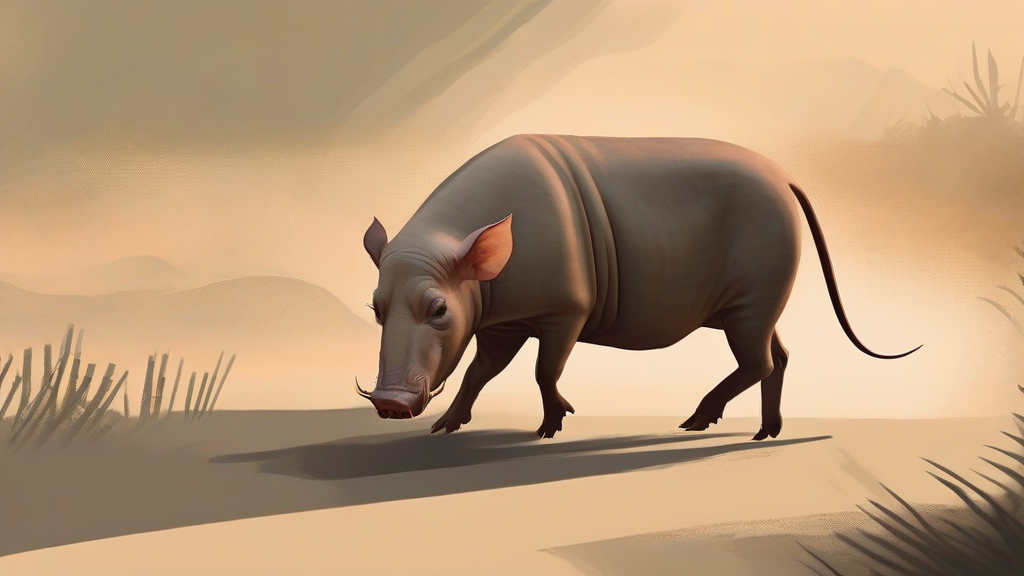
The babirusa is a striking wild pig found only on the Indonesian islands of Sulawesi and a few neighbouring islands, where it inhabits tropical rainforests and riverine habitats. Its most famous feature is the tusk anatomy of the males: the upper canine teeth grow upward rather than outward, piercing the flesh of the snout and curving back toward the eyes, a trait so unusual that early naturalists compared it to a deer's antlers — hence the Malay-derived name meaning 'pig-deer'. Scientifically placed in the genus Babyrousa within the pig family Suidae, the babirusa is considered vulnerable, threatened by deforestation and hunting. In English, the word appears almost exclusively in zoological, conservation, and natural-history contexts, carrying connotations of rarity and biological curiosity. For readers, 'babirusa' is a memorable example of how language preserves vivid folk observation — here, a name coined centuries ago by Malay speakers who saw something pig-like yet antlered in this extraordinary animal.
nounA wild pig native to the Indonesian islands of Sulawesi and nearby islands, the males of which have distinctive upward-curving upper canine teeth that can pierce through the skin of the snout.
- The babirusa itself (genus Babyrousa), a rare wild suid of Indonesia with remarkable tusk anatomy.
"At the zoo's new exhibit, visitors marveled at the babirusa, whose curved tusks gave it an almost prehistoric appearance."
"Conservationists are working to protect the babirusa, whose rainforest habitat on Sulawesi is rapidly shrinking."
"In Malay, 'babirusa' literally means 'pig-deer', reflecting how the animal's tusks reminded early observers of a deer's antlers."
When discussing multiple individuals, 'babirusas' is standard; when speaking of the species as a whole, the singular form is often retained.
"Several babirusas were observed drinking at the riverbank at dawn."
The male babirusa's upper tusks grow straight up through its own snout and curve back toward its forehead — earning it the nickname 'deer-pig' in Malay.
Reviewed by Deb Chak, Editor. AI-assisted content curated by RJS Tech Solutions LLP.
Etymology of babirusa
The word 'babirusa' comes directly from Malay, combining 'babi' (pig) and 'rusa' (deer), a name given because the male's unusual upward-curving tusks suggested a deer's antlers on a pig's body. European naturalists adopted the term when describing the animal, and it entered scientific and general English usage during the period of Dutch colonial exploration of the East Indies, from around the 17th century onward. It shares its Malay roots with other loanwords into English such as 'orangutan' and 'amok'.
How babirusa is actually used
A specialist term encountered mainly in zoology, wildlife conservation, and natural-history writing; it is not part of everyday general vocabulary.