What does backyard mean?
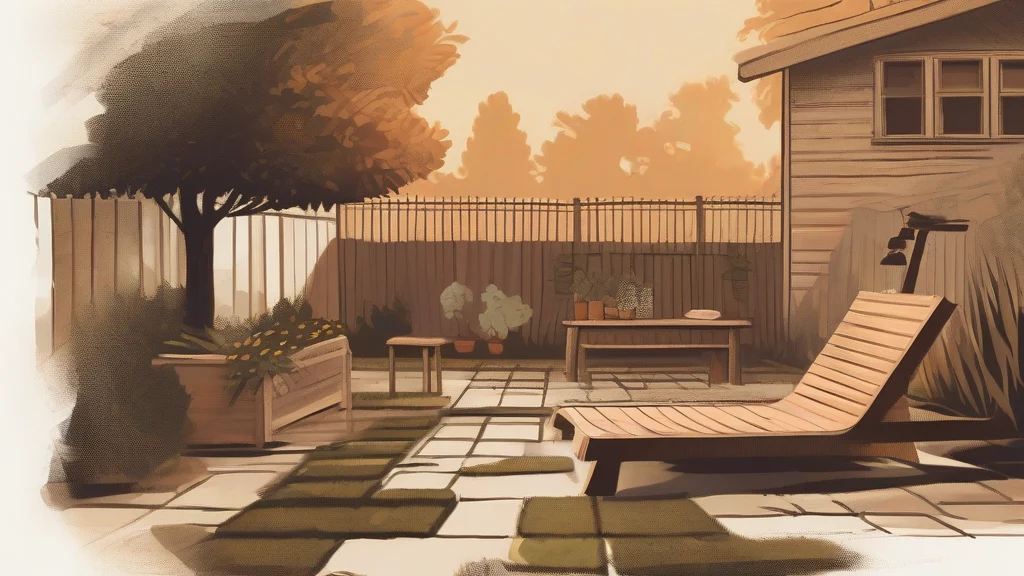
A backyard is the area of land at the rear of a house, typically enclosed by fences or hedges and used for activities such as gardening, barbecuing, children's play, and relaxation. In British English the equivalent space is more often called the 'back garden', while 'backyard' is the standard term in American, Canadian, and Australian English. Beyond its literal meaning, especially in North America the word carries a well-known figurative sense: one's own locality or sphere of concern, as in phrases like 'in my own backyard' or the famous 'not in my backyard' objection — abbreviated NIMBY — which describes opposition to nearby developments such as landfills or housing projects. The word evokes domesticity, privacy, and everyday life; the backyard barbecue, in particular, holds an iconic place in suburban culture. Simple and familiar though it seems, 'backyard' thus spans both physical geography and social attitudes toward community change.
The area of ground at the back of a house, typically walled or fenced, used for recreation, cultivation, or storage.
"We ate dinner at the table we'd set up under the oak tree in the backyard."
In British English, 'back garden' is the more idiomatic equivalent.
One's own local area, neighborhood, or immediate sphere of concern, especially in political discussion.
"The council plans to build the new depot somewhere other than our backyard."
Regular plural; used when referring to the rear yards of multiple properties, e.g. neighboring houses.
"The row of backyards behind Maple Street all backed onto the same creek."
The phrase 'not in my backyard' became so widespread that it spawned its own famous acronym: NIMBY.
Reviewed by Deb Chak, Editor. AI-assisted content curated by RJS Tech Solutions LLP.
Etymology of backyard
Backyard is simply the combination of two native English words: 'back', from Old English 'bæc', and 'yard', from Old English 'geard', meaning an enclosure or dwelling-place (a word related to the same Germanic root that gave 'garden'). The compound emerged in English once houses were built close enough together for the space behind them to be distinct from the front of the property. Its figurative extension to mean one's own local area is a later, chiefly American development, crystallized in the twentieth-century phrase 'not in my backyard'. Cognates sharing the Old English root of 'yard'/'geard' include 'garden', 'garth', and 'orchard'.
How backyard is actually used
Informal to neutral register. The figurative sense ('one's own area') is chiefly American; British speakers more commonly use 'back garden' for the literal sense. The compound 'backyard' is written as one word, not hyphenated.
Easily confused with backyard
A garden is specifically cultivated with plants and flowers, while a backyard is the whole rear area of a property, which may include patios, sheds, lawns, or play equipment as well as any garden space.