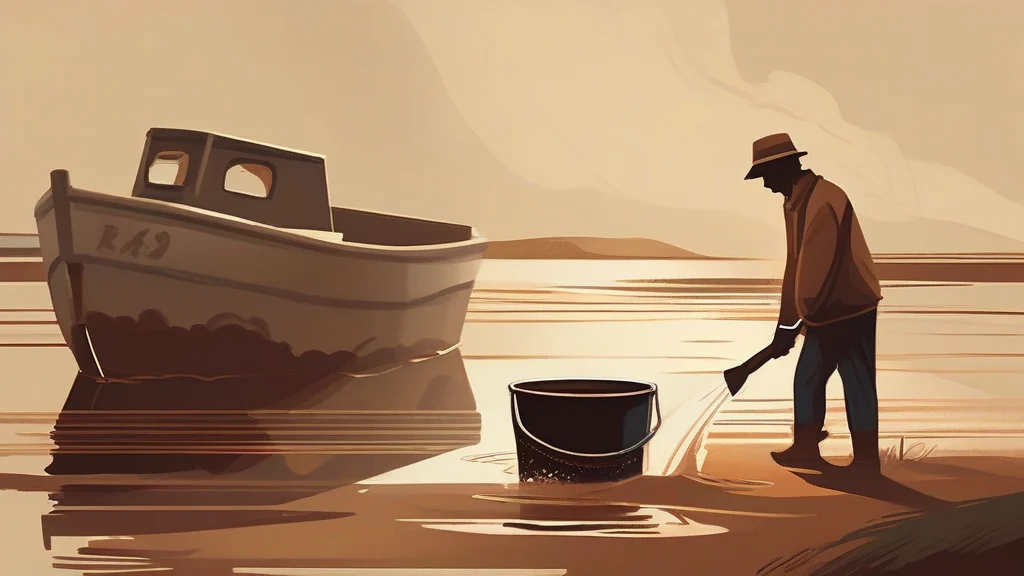
What does bailer mean?
A bailer is either a person or, more commonly today, an implement used to remove water from a boat. Before mechanical bilge pumps existed, keeping a vessel dry depended entirely on human effort: sailors scooped seawater over the side using buckets, ladles, or purpose-made shallow containers, and anyone assigned this exhausting duty was called the bailer. Even now, small craft such as dinghies, canoes, and lifeboats routinely carry a hand bailer as essential safety equipment, and maritime regulations in many countries list it alongside flares and life jackets. The word carries a distinctly nautical flavor and appears most often in sailing, rowing, and safety-inspection contexts. Though modest in scope, the term preserves a vivid link to centuries of seafaring labor, recalling the era when staying afloat meant literally hurling the ocean back where it came from.
nounA person who removes water from a boat by scooping it out; also, a shallow bucket or other implement used for bailing water out of a vessel.
- A person who bails water out of a boat.
- A bucket or other implement used to scoop water out of a vessel.
"When the storm tore a seam in the hull, the crew worked in shifts as bailer to keep the dinghy afloat."
"The old wooden skiff shipped water steadily, so someone always had to serve as bailer on the crossing."
"Regulations require every open boat to carry a bailer or bilge pump among its safety gear."
Standard plural; applies to both the person and the implement senses.
"Each of the club's training boats is equipped with two bailers."
Every lifeboat regulation that mandates a 'bailer' traces back to the oldest survival trick in seafaring — scooping the sea back out before it swallows you.
Reviewed by Deb Chak, Editor. AI-assisted content curated by RJS Tech Solutions LLP.
Etymology of bailer
The word bailer derives from the English verb 'to bail,' meaning to scoop water out of a boat, which has been part of the language since at least the medieval period. Its precise ultimate origin is debated, though it is generally linked to the verb's early forms rather than to the unrelated legal word 'bail,' which comes from Old French 'baillier' ('to deliver, entrust'). The agent-noun suffix '-er' was added to produce both the person who performs the action and the tool used for it. Cognates within English include the family of 'bail'-derived terms such as bailiff and bailey, though these belong to the legal branch of the word rather than the nautical one.
How bailer is actually used
The term belongs chiefly to nautical and maritime-safety contexts and is largely informal in register. In modern usage the word more often denotes the implement than the person, since manual bailing is now usually a last resort when pumps fail.
Easily confused with bailer
A baler is a farm machine that compresses cut material such as hay into bales, whereas a bailer removes water from a boat.
A bailor is a party in law who entrusts property to another (a bailee); it has nothing to do with removing water.