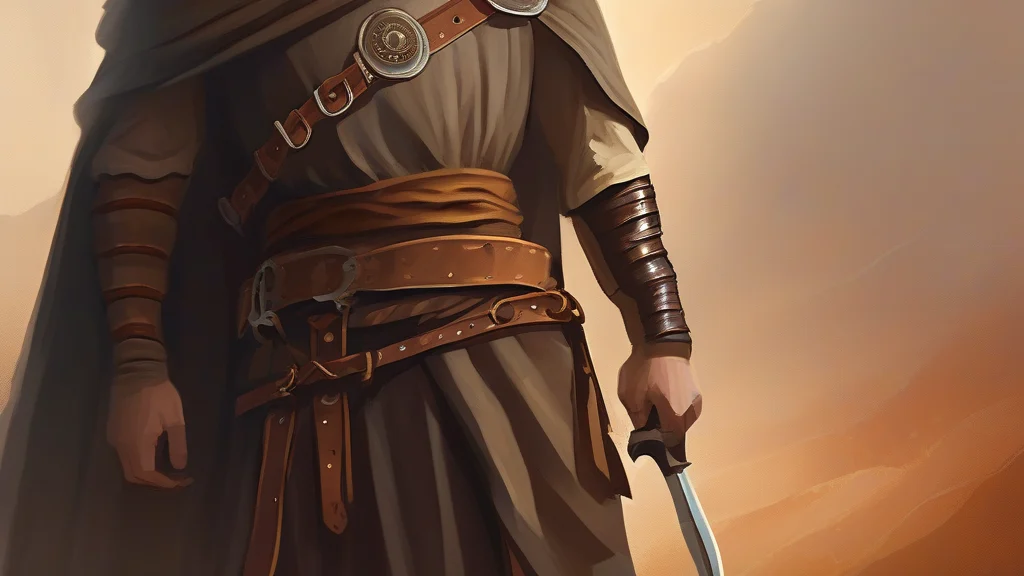
What does baldric mean?
A baldric is a belt worn diagonally across the torso, passing over one shoulder and under the opposite arm, designed to carry a weapon such as a sword at the wearer's hip. Typically fashioned from leather and frequently adorned with buckles, studs, or embroidery, it distributes the weight of a heavy blade while keeping the hands free. The word also extends to similar shoulder straps used to bear horns or drums. Today the baldric survives largely in historical and imaginative contexts: museum displays of arms and armor, ceremonial military dress, reenactment, and the costume design of fantasy and period drama. Its closest living relative is the bandolier, which performs the same diagonal function for ammunition rather than swords. Though obsolete as practical equipment, the baldric remains a vivid emblem of knighthood and martial pageantry, making it a useful word for readers of history, heraldry, and literature alike.
nounA baldric is a belt worn over one shoulder and across the chest, used to support or carry a sword, horn, or drum. It is typically made of leather and often decorated with metal fittings.
- A belt worn over one shoulder and across the body for carrying a sword or other weapon.
- By extension, a similar shoulder strap used to support a horn or drum.
"The knight slung his sword in a leather baldric that crossed his chest from shoulder to hip."
"He adjusted his baldric so the sword hung comfortably at his left hip."
"In the portrait, the general wears an ornate gold-studded baldric across his breastplate."
The standard plural simply adds -s; it occurs mainly in collections, inventories, or descriptions of multiple figures wearing them.
"The armory displayed a row of baldrics studded with silver bosses."
The baldric let medieval knights draw a heavy sword smoothly from the hip — and its cousin, the bandolier, still crosses soldiers' chests today.
Reviewed by Deb Chak, Editor. AI-assisted content curated by RJS Tech Solutions LLP.
Etymology of baldric
Baldric entered Middle English from medieval French, where the corresponding word was 'baudrier', itself descended from the Latin 'balteus', meaning a soldier's belt. The same Romance lineage produced the Spanish 'bandolera' and, through French, the English 'bandolier', which shares the idea of a shoulder-slung strap. The word has been part of English since the medieval period and appears regularly in descriptions of arms and armor thereafter.
How baldric is actually used
Baldric belongs chiefly to historical, military, heraldic, and literary registers; it appears rarely in everyday modern conversation except in discussions of armor, costume design, or fantasy fiction. It is a formal, somewhat archaic term with no informal usage. Both 'baldric' and the variant spelling 'baldrick' are attested.
Easily confused with baldric
A bandolier is a shoulder belt for carrying ammunition cartridges, whereas a baldric carries a sword or other weapon.
A baldachin is a ceremonial canopy over an altar or throne, unrelated in meaning to the shoulder-worn baldric despite the similar spelling.