What does balefire mean?
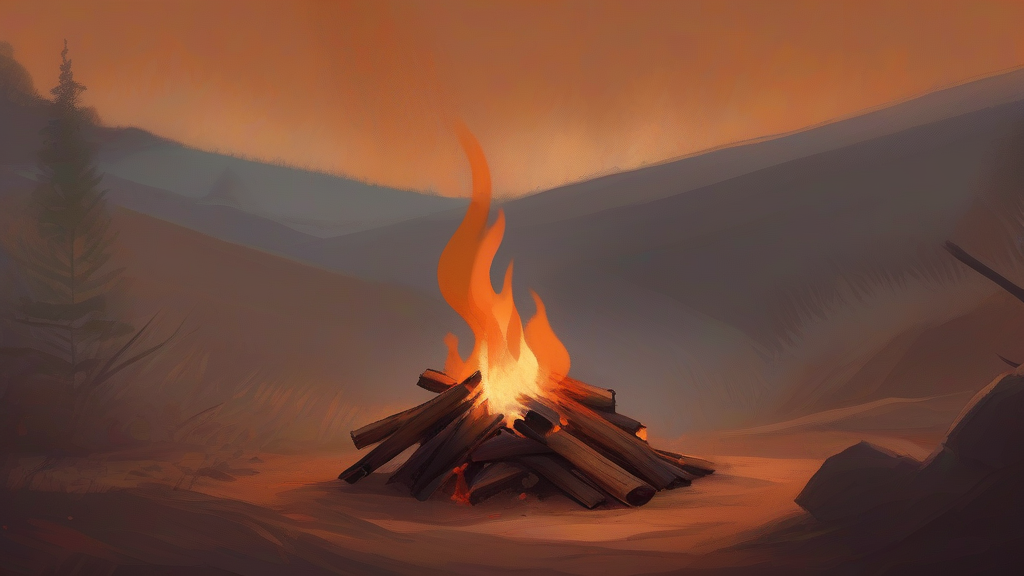
A balefire is a large outdoor fire, historically lit on high ground as a signal or warning that could be seen from far away, and later also used to describe a celebratory bonfire kindled for festivals or communal gatherings. In an age before telegraphy, chains of balefires relayed urgent news — such as the approach of an enemy fleet — from hilltop to hilltop across entire regions. The word carries strong historical and literary connotations: it evokes beacons blazing on ridgelines, watchmen scanning the horizon, and communities gathered around flames at midsummer or other traditional observances. Though largely archaic in everyday speech, where 'bonfire' or 'beacon' has taken its place, balefire survives readily in historical writing and fantasy literature, where its evocative sound and ancient pedigree lend atmosphere. It is a countable noun with the plural 'balefires', and it remains a word valued precisely for the vivid, pre-modern world it conjures.
nounA large outdoor fire; originally one lit as a signal or warning beacon, and later also a celebratory bonfire.
- A large open-air fire lit as a signal or warning beacon, visible over long distances.
- A festive bonfire kindled for a celebration or observance.
"From the hilltop, the villagers lit a balefire to warn the neighbouring settlements of approaching ships."
"Watchmen on the ridge lit the balefire, and within minutes answering flames appeared on distant hills."
"The village gathered around the midsummer balefire as the fiddlers struck up a tune."
Standard regular plural, used when referring to multiple fires, especially a chain of signal fires.
"Balefires blazed along the whole length of the coast road that night."
Before telegraphs and radios existed, a chain of hilltop balefires could carry a message across an entire country in hours — one flame at a time.
Reviewed by Deb Chak, Editor. AI-assisted content curated by RJS Tech Solutions LLP.
Etymology of balefire
Balefire comes from Middle English, combining 'bale' — an old word for a funeral pyre or burning, derived from Old English bǣl and ultimately connected to Old Norse bál — with 'fire'. In its earliest uses the word was associated with funereal and signal blazes, and over time it broadened to cover any great outdoor fire lit for signalling or celebration. The Old English root bǣl also underlies the archaic standalone word 'bale' meaning a pyre, though this is unrelated to the modern 'bale' meaning a bundled quantity of goods, which has a separate origin.
How balefire is actually used
Largely archaic or literary today; 'beacon' or 'bonfire' is more common in modern speech. Carries an evocative, historical connotation, often used in fantasy fiction and historical writing to suggest pre-industrial communication or communal ritual.
Easily confused with balefire
Balefire is an actual fire or blaze, while baleful describes a menacing or harmful look, influence, or expression.
In modern usage a bale is a large bundled quantity of goods such as hay or cotton, whereas a balefire is a fire; only in the archaic sense did 'bale' mean a funeral pyre.