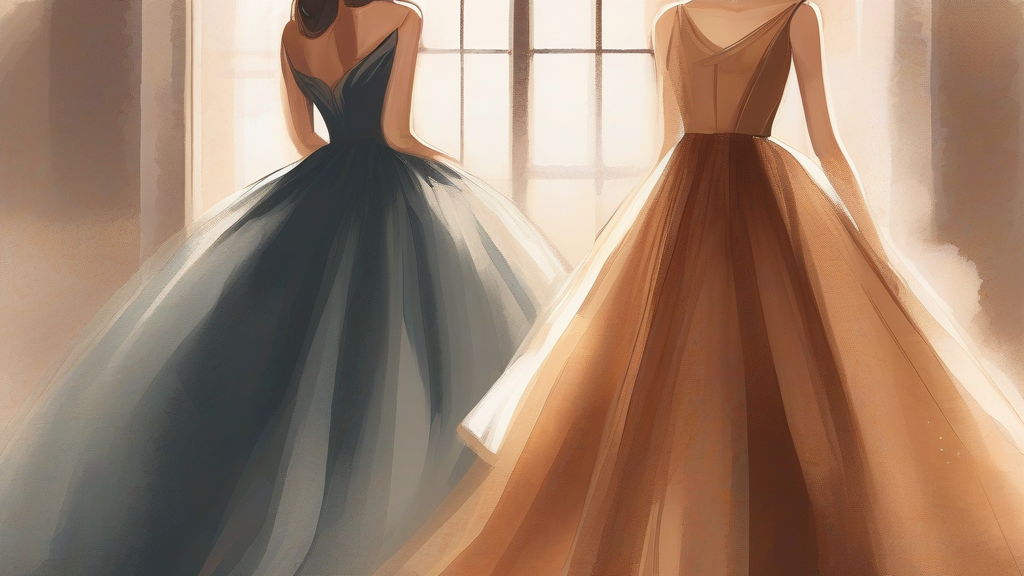
What does ballgown mean?
A ballgown is a long, formal dress designed for grand social occasions such as balls, galas, and debutante events. Its defining feature is a full, voluminous skirt that falls to the floor, traditionally supported by petticoats or crinolines, often paired with a fitted bodice and an off-the-shoulder or low neckline. The word evokes elegance, luxury, and ceremony, appearing frequently in fashion journalism, historical accounts of aristocratic life, and fairy-tale storytelling — Cinderella's transformation into a gowned beauty is perhaps its most famous cultural touchstone. Though written as one word in British English, American texts sometimes render it as "ball gown." While modern formalwear has largely shifted toward slimmer silhouettes, the ballgown endures on red carpets, at royal weddings' attendant festivities, and in couture collections, where designers continually reinterpret its dramatic silhouette. As a vocabulary item, it neatly captures how clothing terms preserve social history: the garment itself signals rank, ritual, and celebration.
nounA long, formal gown worn to a ball or other formal social occasion, typically featuring a full skirt and often an off-the-shoulder or low neckline.
- A long formal dress with a full skirt, worn especially to balls and formal dances.
"She wore a silk ballgown to the charity gala, the skirt sweeping across the dance floor."
"Cinderella arrived at the palace in a shimmering blue ballgown."
"The museum displayed ballgowns worn by duchesses at nineteenth-century court balls."
Standard plural, used when referring to multiple such garments, e.g. in collections or exhibitions.
"The exhibition featured ballgowns spanning three centuries of fashion."
The classic ballgown's full skirt was originally practical: it gave dancers room to move — and hid their feet entirely from view beneath layers of petticoats.
Reviewed by Deb Chak, Editor. AI-assisted content curated by RJS Tech Solutions LLP.
Etymology of ballgown
The word "ballgown" combines two older English terms: "ball," meaning a formal dancing party (from the Old French "bal", ultimately of Germanic origin), and "gown," a long outer garment borrowed from Old French " goune", likely of Germanic origin as well. The compound arose as formal dancing attire became a distinct category of dress, with the term well established by the eighteenth and nineteenth centuries, when balls were central to elite social life. Its cognates include the French words "bal" and "robe de bal".
How ballgown is actually used
"Ballgown" is usually written as one word in British usage; American sources sometimes write it as two words ("ball gown"). It carries connotations of formality, luxury, and old-fashioned grandeur, and appears most often in fashion writing, historical contexts, and fairy-tale imagery. The word is standard rather than colloquial, but its associations are distinctly traditional and romantic.
Easily confused with ballgown
An evening gown is any long formal dress, whereas a ballgown specifically has a full, voluminous skirt in the style traditionally worn for dancing at balls.