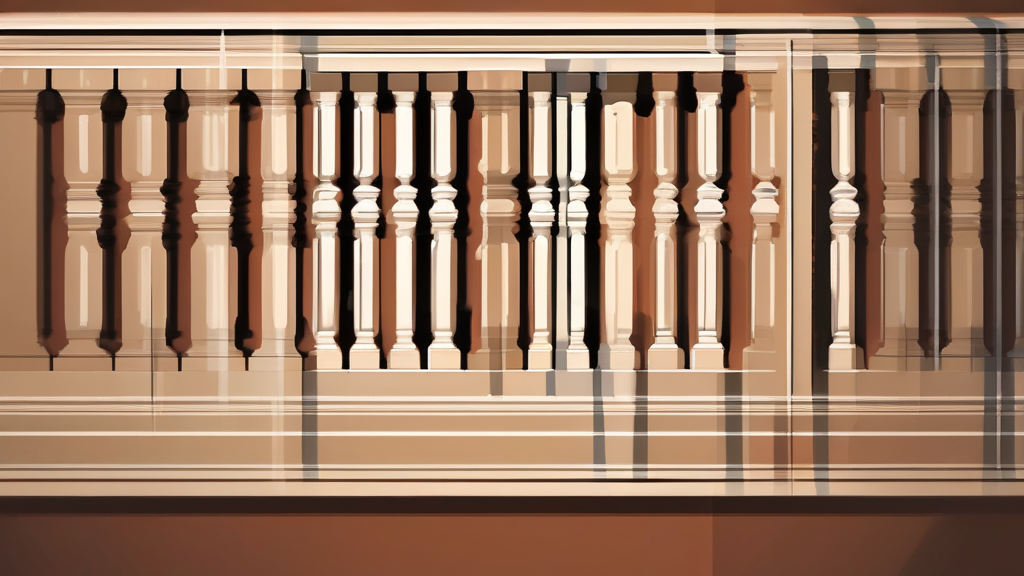
What does balustrade mean?
A balustrade is a decorative and functional railing made up of a row of short pillars, known as balusters, capped by a horizontal rail or coping. Balustrades line the edges of staircases, balconies, terraces, porches, and bridges, preventing falls while lending an air of elegance and formality to architecture. The term is most at home in architectural writing and descriptions of classical or grand buildings, where balustrades in stone, marble, or wrought iron are signature features of Renaissance, Baroque, and neoclassical design. The word derives ultimately from Italian and French forms related to balausta, the wild pomegranate blossom whose rounded shape inspired the classic profile of the baluster. Though closely associated with banisters and railings, a balustrade refers to the whole assembled structure rather than any single element, making it a precise and useful term for anyone describing built environments with care.
nounA railing supported by a row of small posts called balusters, running along the edge of a staircase, balcony, terrace, or bridge.
- A continuous railing composed of a series of balusters joined by a rail or coping, typically found along staircases, balconies, terraces, and parapets.
"She leaned against the marble balustrade, watching the sun set over the piazza."
"The grand staircase was framed by an ornate wrought-iron balustrade that spiralled up to the gallery."
"Visitors gathered along the stone balustrade of the terrace to watch the procession below."
The standard plural simply adds '-s'. It appears when referring to multiple structures, such as those lining several terraces or flights of stairs.
"The palace's twin staircases were each bordered by matching bronze balustrades."
The word 'balustrade' comes from an Italian name for the pomegranate flower — early balusters were shaped like its bulbous form.
Reviewed by Deb Chak, Editor. AI-assisted content curated by RJS Tech Solutions LLP.
Etymology of balustrade
Balustrade entered English in the early seventeenth century, borrowed from French balustrade, which derived from Italian balaustrata, meaning 'provided with balusters'. The underlying word balusto comes from Latin balausta, a term for the wild pomegranate fruit or blossom whose swelling, vase-like shape suggested the form of the classical baluster. The same Latin root gives us the rare botanical term balaustine.
How balustrade is actually used
The word is chiefly used in architectural and formal descriptive contexts. In everyday speech about stairs, people more often say 'banister' or 'railing'; 'balustrade' tends to appear in discussions of buildings, gardens, bridges, and classical design.
Easily confused with balustrade
A banister is the handrail itself or a single supporting post on a stairway, while a balustrade is the complete row of balusters together with the rail they support.
A baluster is one individual post or pillar of the railing; a balustrade is the entire structure formed by many balusters topped by a rail.