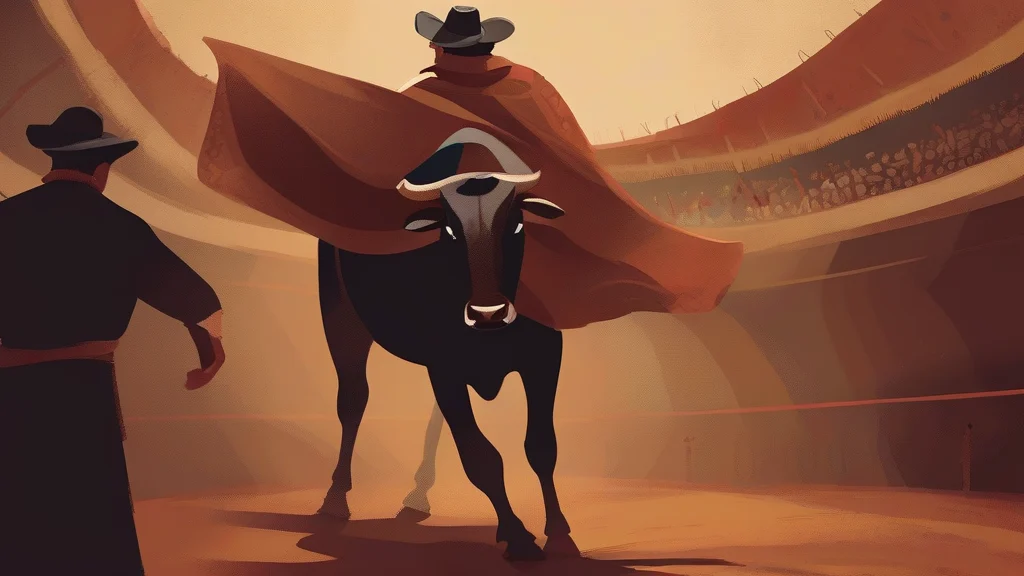
What does banderillero mean?
A banderillero is one of the professional bullfighters who take part in a traditional Spanish corrida, distinguished by the task of planting banderillas — slender, colorfully ribboned darts tipped with small barbs — into the shoulders of the charging bull. Working in teams called cuadrillas under a leading matador, banderilleros typically place two pairs of darts apiece during the second stage of the fight, a phase known as the tercio de banderillas. Their role demands agility and precision: they must approach the bull closely and withdraw safely without wounding it further than intended. The word derives from Spanish, built directly on banderilla, the diminutive of bandera, meaning flag or banner, so a banderillero is literally 'the bearer of little banners.' Because the term belongs to a specific cultural practice rather than general vocabulary, it appears chiefly in journalism, travel writing, and literature about Spain and Latin American bullfighting traditions, where it conveys the pageantry and ritual of the corrida.
nounA banderillero is one of the bullfighters in a Spanish-style corrida who plants banderillas — decorated barbed darts — into the bull's shoulders during the course of the fight.
- A member of a matador's cuadrilla who plants banderillas (decorated barbed darts) in the bull's shoulders during a bullfight.
"The banderillero stepped forward and deftly planted his pair of darts as the bull charged."
"The crowd applauded as the banderillero planted both darts with a single fluid motion."
"After years as a banderillero, he finally earned his own top billing as a matador."
The plural follows regular English patterns by adding -s; the word is sometimes italicized in print as a foreign loanword, but the plural remains unchanged.
"The cuadrilla included two experienced banderilleros and a picador."
In the Spanish corrida, three banderilleros traditionally each plant two pairs of darts — meaning six sets of barbed banderillas land before the matador ever draws his sword.
Reviewed by Deb Chak, Editor. AI-assisted content curated by RJS Tech Solutions LLP.
Etymology of banderillero
The word banderillero comes from Spanish, formed from banderilla — the diminutive of bandera ('flag' or 'banner') — plus the agentive suffix '-ero', giving the sense 'one who handles the little banners.' The darts themselves are named for their bright ribbons, which flutter like tiny flags once set in the bull's shoulders. Banderilla ultimately traces back through Spanish to the Germanic root underlying words such as banner and banderole, which entered Romance languages via Frankish influence. English borrowed banderillero directly from Spanish in the nineteenth century alongside other tauromachy terms such as matador, picador, and toreador.
How banderillero is actually used
Banderillero is a specialized term of Spanish bullfighting (tauromachy) and appears almost exclusively in writing about that tradition. It carries no everyday use outside this context, and its register is neutral to literary.
Easily confused with banderillero
A banderilla is the decorated barbed dart itself, while a banderillero is the bullfighter who places it in the bull.
A picador weakens the bull's neck muscles with a lance on horseback, whereas a banderillero plants short darts on foot.