What does bandog mean?
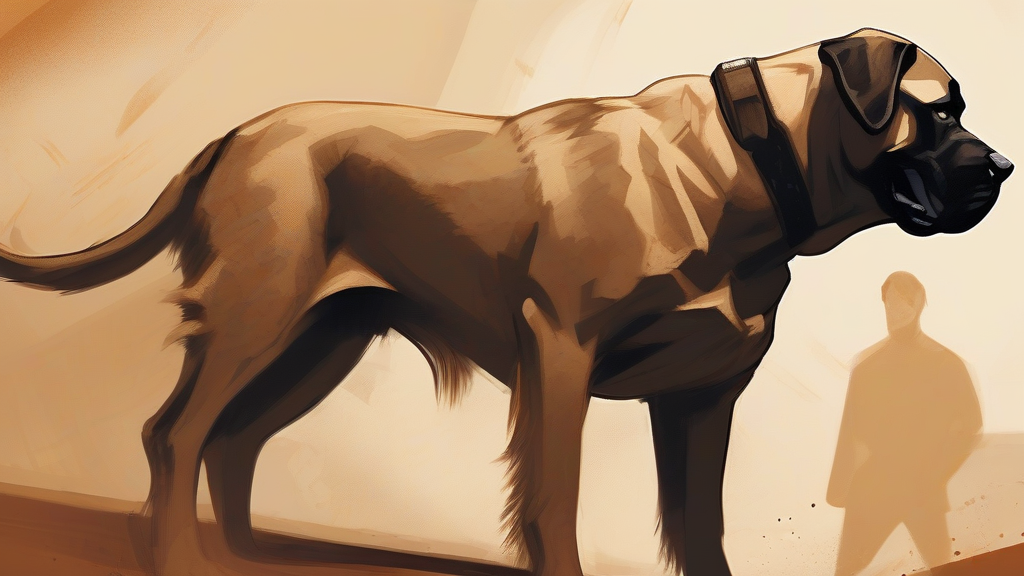
A bandog is a fierce guard dog — historically one that was chained or 'banded' during the day and unleashed at night to protect a house or estate. The word comes from Middle English, formed simply by combining 'band' with 'dog', and appears in literature from the medieval period onward, most famously in the opening scene of Shakespeare's Romeo and Juliet. Bandogs were valued for their size, strength, and aggression toward strangers, in contrast to hunting dogs or gentle household companions. Today the term is archaic and literary, evoking an era when property was defended by tethered mastiffs, though it retains a place in historical fiction and among enthusiasts of large guard-dog breeds. Its connotations are consistently menacing: to call a dog a bandog is to emphasize its ferocity rather than its loyalty or beauty.
nounA bandog is a fierce guard dog, traditionally one chained or tethered to guard a house or property. The word is now largely historical or literary.
- A ferocious guard dog, especially one kept chained to protect a house or estate.
"The old manor was guarded by a snarling bandog that no stranger dared approach."
"Shakespeare's Romeo and Juliet opens with servants trading insults about their masters' bandogs."
"By day the bandog slept in its kennel, but at night it patrolled the courtyard on its heavy chain."
Standard pluralization; occasionally seen in the archaic spelling 'bandogges' in early modern texts.
"The estate kept two bandogs, each chained at a separate entrance after dark."
A bandog isn't just any dog — it's a dog literally named for being bound: 'band' + 'dog', a medieval guard dog kept on a chain until intruders arrived.
Reviewed by Deb Chak, Editor. AI-assisted content curated by RJS Tech Solutions LLP.
Etymology of bandog
Bandog derives from Middle English, where it was formed transparently from 'band' (a chain or tether) plus 'dog' — literally, a dog kept on a band. The term was well established by the late Middle Ages and passed into early modern English, appearing in writers such as Shakespeare. It reflects the medieval practice of chaining powerful dogs by day and loosing them as guards at night. No close cognates exist beyond this English formation, since the word arises from a native compound rather than borrowing from another language.
How bandog is actually used
Bandog is an archaic or literary term, familiar mainly from older English texts such as Shakespeare. It carries connotations of savagery and menace rather than companionship. In modern usage the word survives mostly in historical fiction and discussions of medieval life, though 'bandogge' has been revived as a label among breeders of large working mastiff-type dogs.
Easily confused with bandog
A bandage is a strip of fabric used to bind a wound, while a bandog is a fierce guard dog; the words merely share the 'band-' spelling element.