What does banister mean?
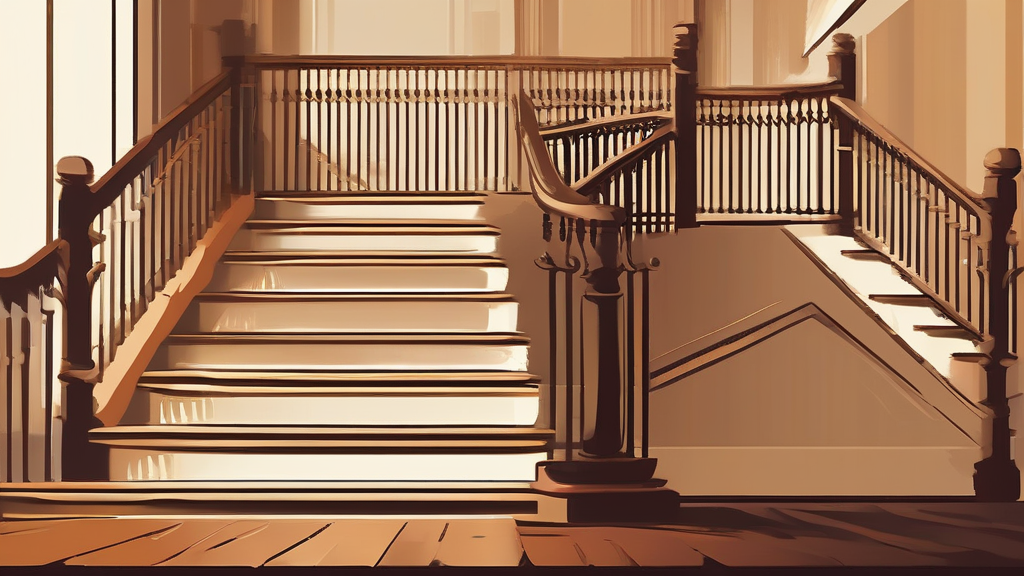
A banister is the handrail running alongside a staircase, held up by short vertical posts known as balusters. In casual usage, particularly in North America, the term frequently covers the whole assembly — rail, balusters, and newel posts together — though technically it denotes just the rail that the hand grips. Banisters are typically made of wood, metal, or stone, and because they are touched constantly they often acquire a distinctive sheen over years of use. The word entered English in the seventeenth century as an altered form of 'baluster', which ultimately derives from Greek 'balaustion', the name for the flower of the wild pomegranate whose shape resembled these ornamental pillars. Closely related terms include 'balustrade', the full row of balusters topped by a rail, a design famously used on classical buildings and balconies. Whether describing a grand curved stairway in a historic house or an ordinary domestic staircase, the banister is both a practical safety feature and a subtle marker of a home's architectural character.
nounA handrail fixed at the side of a staircase, supported by vertical posts called balusters; the term also refers to such a rail collectively with its supports.
- The sloping handrail of a staircase, supported by balusters or newel posts
- (loosely) the entire stair-rail assembly including its supporting balusters
"She ran her hand along the polished wooden banister as she descended the stairs."
"He gripped the banister tightly as he climbed the steep stairs."
"The oak banister gleamed after decades of hands had polished it smooth."
Regular plural, used when referring to multiple rails or several staircases.
"The mansion's sweeping staircases all featured carved mahogany banisters."
'Banister' is actually a corruption of 'baluster' — a word that traces back to the Greek for a wild pomegranate flower.
Reviewed by Deb Chak, Editor. AI-assisted content curated by RJS Tech Solutions LLP.
Etymology of banister
Banister arose in early seventeenth-century English as an altered form of 'baluster', the French-derived term for a small supporting pillar. The French word 'balustre' came from Italian 'balaustro', which in turn traces to Greek 'balaustion', meaning the blossom of the wild pomegranate, whose swelling shape suggested the pillar's profile. Over time the spelling drifted to 'banister', and its meaning shifted from the individual pillar to the handrail those pillars support.
How banister is actually used
In everyday use, especially in North America, 'banister' often means the entire stair-rail assembly rather than only the handrail; architects and dictionaries more precisely reserve it for the rail itself. The spelling 'bannister' is a common variant but is not the preferred form.
Easily confused with banister
A balustrade is the complete row of balusters plus the rail, while a banister is commonly just the handrail (or loosely the whole assembly) of a staircase.
'Bannister' is a variant or misspelling of 'banister'; the standard spelling is 'banister', whereas 'Bannister' as a surname refers to people such as runner Roger Bannister.