What does banksia mean?
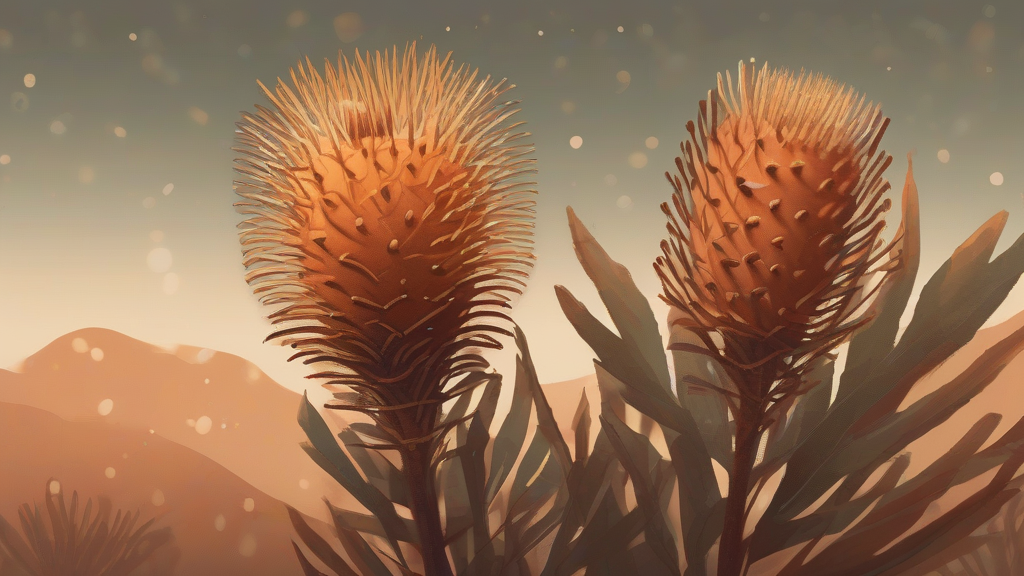
A banksia is any member of Banksia, an Australian genus of roughly 170 species of woody shrubs and small trees in the protea family (Proteaceae). The genus takes its name from Sir Joseph Banks, the naturalist who gathered the first specimens during Captain Cook's Endeavour voyage of 1770. Banksias are instantly recognizable by their upright, cylindrical flower spikes — often likened to brushes or candles — which range from pale yellow to deep orange-red, and by their tough, woody seed cones. Many species are adapted to bushfire: some cones open only when heated by flame, releasing seeds onto ash-enriched soil. Ecologically vital, banksias supply nectar to birds, insects, and small mammals, and they hold cultural significance in Aboriginal traditions. In horticulture they are prized as low-maintenance native ornamentals, especially in Australia, where they appear widely in gardens, landscaping, floristry, and even on postage stamps and coins as national icons.
nounA banksia is a shrub or tree of the Australian genus Banksia, family Proteaceae, bearing dense cylindrical spikes of small flowers and distinctive woody seed cones.
- Any shrub or tree of the genus Banksia, native to Australia, characterized by spikes of small flowers and hard woody fruiting cones.
"The garden's banksias burst into golden bloom just as the honeyeaters arrived for winter."
"Coastal banksias line the cliff path, their candle-like flower spikes glowing against the grey sea."
"She pressed a dried banksia cone into the arrangement as a striking sculptural accent."
As a countable noun referring to plants of the genus, banksia pluralizes regularly as "banksias."
"Several banksias along the driveway were planted by the property's first owners."
Named after botanist Sir Joseph Banks, who collected specimens on Captain Cook's 1770 voyage to Australia, banksias are so fire-adapted that some species need a blaze to open their woody cones and release their seeds.
Reviewed by Deb Chak, Editor. AI-assisted content curated by RJS Tech Solutions LLP.
Etymology of banksia
The word "banksia" derives directly from the name of Sir Joseph Banks, the English naturalist aboard HMS Endeavour who collected the first banksia specimens at Botany Bay in 1770. Linnaeus formally erected the genus in his honor, making it one of the earliest plant genera named after an individual European scientist associated with Australia's flora. As a scientific generic name adopted into general usage, it has no cognates beyond other taxa commemorating individuals rather than shared linguistic roots.
How banksia is actually used
"Banksia" is used chiefly in botanical, horticultural, and Australian contexts; it carries no negative connotation and appears most often in writing about native plants and gardens.
Easily confused with banksia
A protea is a related but distinct genus of southern African flowering plants in the same family (Proteaceae), whereas banksias are native to Australia.