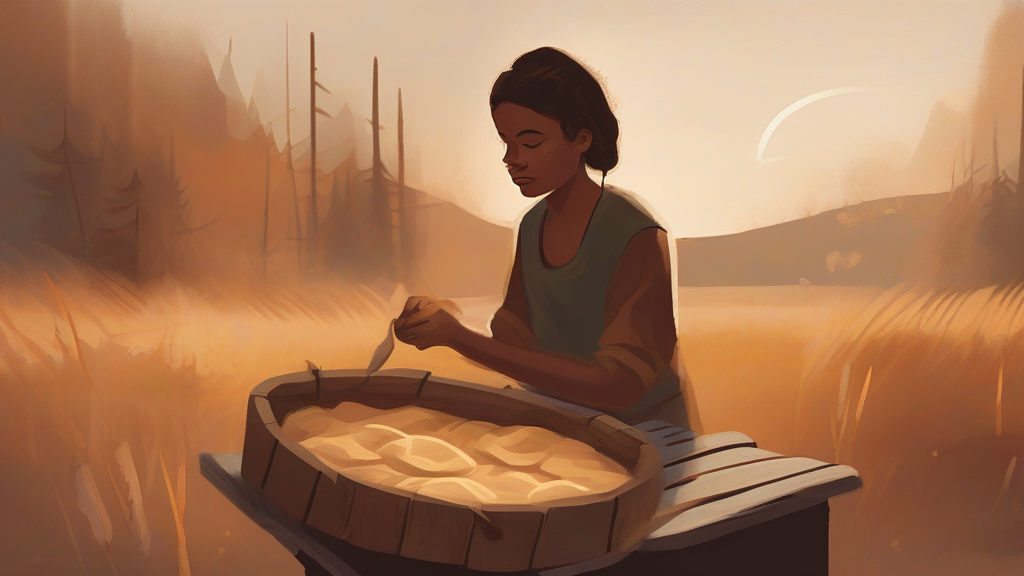
What does bannock mean?
A bannock is a flat, round bread, typically made without yeast or only lightly leavened, and cooked on a griddle, in an oven, or over an open fire. The word has two principal homes. In Scotland, bannocks have long been a traditional staple, ranging from simple oatmeal cakes to the rich, fruit-filled Selkirk bannock once served at festivals and holidays. In Canada and parts of the northern United States, bannock refers to the fried or baked bread that became a cornerstone of Indigenous cooking after European flour was introduced, and it remains a cherished food at community gatherings and powwows today. The term is neutral in register but rich in cultural resonance, evoking hearth cooking, heritage, and hospitality. Because the word covers several distinct regional traditions, context usually makes clear which kind of bannock is meant, whether a Scottish tea bread or a golden piece of frybread fresh from the pan.
nounA flat, round loaf or cake of unleavened or lightly leavened bread, traditionally baked on a griddle or over an open fire. It is especially associated with Scotland and with the traditional cooking of Indigenous peoples of North America.
- A flat, round quick bread baked on a griddle or in an oven, associated especially with Scotland.
- A fried or baked flatbread that is a staple traditional food of many Indigenous peoples of northern North America.
"She cooked a fresh bannock over the campfire and served it warm with butter."
"Her grandmother's Selkirk bannock, dense with raisins, was the centrepiece of every Christmas table."
"At the powwow, vendors sold warm bannock slathered with jam and honey."
The standard plural is regular; 'bannocks' is common in recipes and historical texts describing multiple loaves.
"She set a basket of warm bannocks on the table for the guests."
The same humble word names both a Scottish festival loaf studded with fruit and the beloved frybread of Indigenous communities across Canada — one word, two continents of tradition.
Reviewed by Deb Chak, Editor. AI-assisted content curated by RJS Tech Solutions LLP.
Etymology of bannock
The word bannock comes from Middle English 'banok', borrowed from Old Northern French and ultimately traceable to a Gaulish or Latin source related to 'panis', meaning bread. It has been used in English since at least the medieval period to denote a flat, round loaf. The Scottish Gaelic form 'bannach' reflects the same borrowing, underscoring the word's long association with Scottish baking before it travelled to North America.
How bannock is actually used
The word carries strong regional associations: in Scotland it often refers to a specific oatmeal or fruit loaf (as in Selkirk bannock), while in Canada it is closely tied to Indigenous cuisine, where it may be baked or deep-fried. The term is informal-to-neutral in register and appears frequently in culinary and cultural writing.
Easily confused with bannock
Banns are public announcements of an intended marriage read in church, whereas a bannock is a type of flat bread.