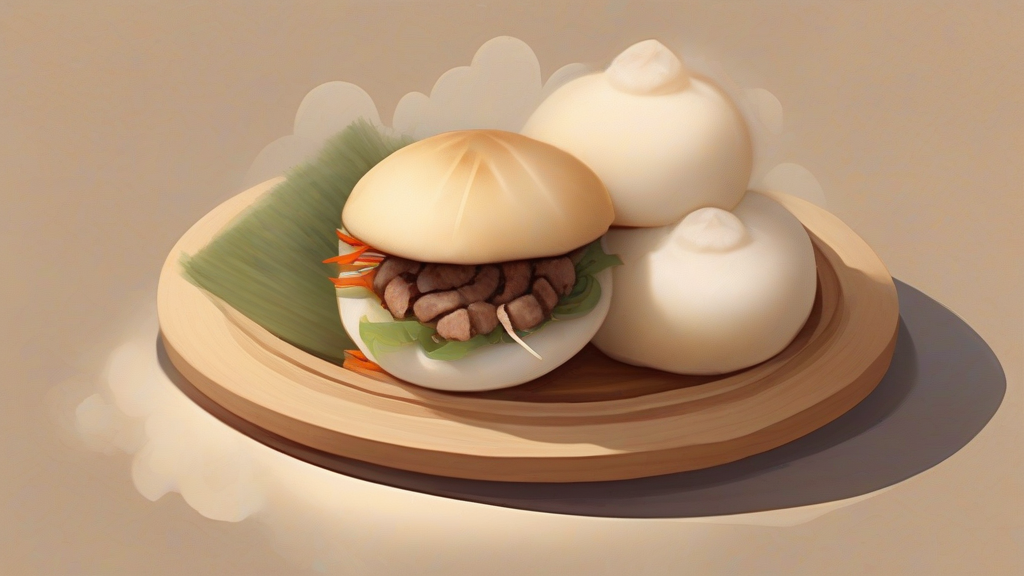
What does bao mean?
A bao is a soft, steamed bun made from leavened wheat dough, a staple of Chinese cuisine that has become popular worldwide. Most baos are filled — classic versions include char siu bao with barbecued pork, and gua bao, a flat folded bun wrapped around braised pork belly, pickles, and peanut powder — though unfilled relatives such as mantou belong to the same family. The word comes from Mandarin bāo, meaning 'to wrap' or 'a package', reflecting the way the dough encloses its filling. In English, bao appears chiefly in culinary contexts: restaurant menus, food blogs, and cookbooks, where it is treated as both a countable noun ('three pork baos') and a collective term for the style of bun. Its rise in the West tracks the broader global enthusiasm for Asian street food, and it now sits comfortably alongside words like ramen and taco as a borrowed food name in everyday vocabulary.
nounA soft, pillowy Chinese steamed bun made from leavened wheat dough, typically filled with seasoned meat, vegetables, or sweet paste. The term also refers more broadly to this style of bun across Chinese and East Asian cuisines.
- A Chinese steamed bun of leavened dough, usually with a savory or sweet filling (e.g. char siu bao).
- More generally, any bun in this wrapped, steamed style found across East and Southeast Asian cuisines.
"She ordered a basket of fluffy pork bao and dipped each one in black vinegar."
"The night market stall sold gua bao stuffed with braised pork belly, pickled mustard greens, and crushed peanuts."
"For breakfast in Taipei, nothing beats a hot bao fresh out of the bamboo steamer."
Both 'bao' (as a mass noun) and 'baos' are accepted; 'baos' is common on menus and in casual speech.
"We split a dozen baos between the four of us."
In 2019, 'Bao' — a Pixar short about a lonely woman whose dumpling comes to life — won an Academy Award, making the humble steamed bun a movie star.
Reviewed by Deb Chak, Editor. AI-assisted content curated by RJS Tech Solutions LLP.
Etymology of bao
The word bao derives from Mandarin Chinese bāo (包), meaning 'to wrap' or 'a bundle', referring to dough wrapped around a filling. It entered English through Chinese immigration and the spread of Chinese restaurants, becoming widespread in English-language food writing in the late twentieth century. Related forms appear across Asia: baozi is the standard Mandarin term for the filled bun, siopao is the Philippine adaptation via Hokkien, and mantou names the unfilled version. These are culinary cousins rather than strict linguistic cognates, all stemming from the same Chinese tradition of steamed wheat dough.
How bao is actually used
Bao entered English through Chinese cuisine and is used informally, especially in food writing and restaurant menus. It is often left untranslated on menus alongside compounds like 'char siu bao'. Some speakers pluralize it as 'baos', though 'bao' can function as a mass noun when referring to the buns collectively.
Easily confused with bao
Bow (rhyming with bao) means a knot with loops, a weapon for shooting arrows, or bending forward — while bao is a filled steamed bun.
A bough is a large branch of a tree, whereas a bao is a steamed wheat-flour bun.