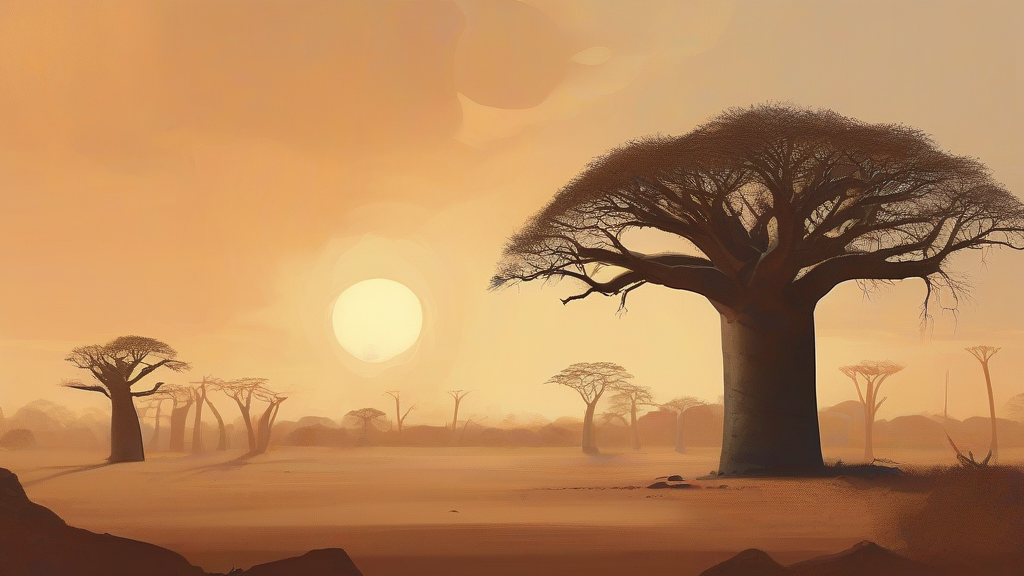
What does baobab mean?
A baobab is a strikingly large tree belonging to the genus Adansonia, native to parts of Africa, Madagascar, and Australia. Baobabs are renowned for their immense, swollen trunks, sparse crown of branches, and extraordinary lifespan — some individuals are believed to be many hundreds or even thousands of years old. The name also applies to the tree's hard-shelled fruit, which contains dry, powdery pulp with a tangy, citrus-like flavour; this pulp is eaten fresh, blended into drinks, or sold as baobab powder prized for its vitamin C content. In everyday language, 'baobab' most often refers to the iconic African savanna tree, where it holds deep cultural significance and features in folklore across the continent. Figuratively, the word can evoke endurance, shelter, and ancient grandeur. Whether encountered on a journey through East Africa, in botanical literature, or on a health-food label, 'baobab' consistently points to one of nature's most memorable plants.
nounA baobab is a massive, thick-trunked tree of the genus Adansonia, native to Africa, Madagascar, and Australia, known for its distinctive swollen trunk and longevity. It also refers to the edible fruit of this tree, which has a tangy flavour and is used in foods and drinks.
- The baobab tree itself (genus Adansonia), famous for its enormous swollen trunk and great age.
- The edible, tangy fruit of the baobab tree, or products derived from it such as baobab powder.
"The travellers rested in the shade of an enormous baobab at the edge of the village."
"We camped beneath a towering baobab whose trunk was wide enough to shelter the whole group."
"She stirred a spoonful of baobab powder into her smoothie for a citrusy boost of vitamin C."
Used when counting or referring to multiple individual trees. When speaking of the fruit or products like powder, the singular uncountable form is standard.
"The landscape was dotted with ancient baobabs, their silhouettes stark against the setting sun."
Some African legends say the gods planted the baobab upside down — its root-like branches pointing at the sky.
Reviewed by Deb Chak, Editor. AI-assisted content curated by RJS Tech Solutions LLP.
Etymology of baobab
The word 'baobab' entered English in the early seventeenth century, borrowed from the French 'baobab', which itself derived from an African source, likely via Arabic traders' rendering of a name used for the tree in West Africa. The genus name Adansonia honours the French botanist Michel Adanson, who studied the tree in Senegal in the eighteenth century. Beyond the genus designation, few true cognates exist in modern European languages outside the various forms of the same borrowing.
How baobab is actually used
The word is neutral and widely used in both scientific writing about Adansonia trees and in commercial contexts marketing baobab fruit as a 'superfood'. It carries connotations of Africa, antiquity, and natural resilience. The plural is typically 'baobabs', though the word is often treated as uncountable when referring to the fruit or its products.
Easily confused with baobab
Baboon is a large primate, while baobab is a tree; the two share no connection beyond a superficial sound resemblance.