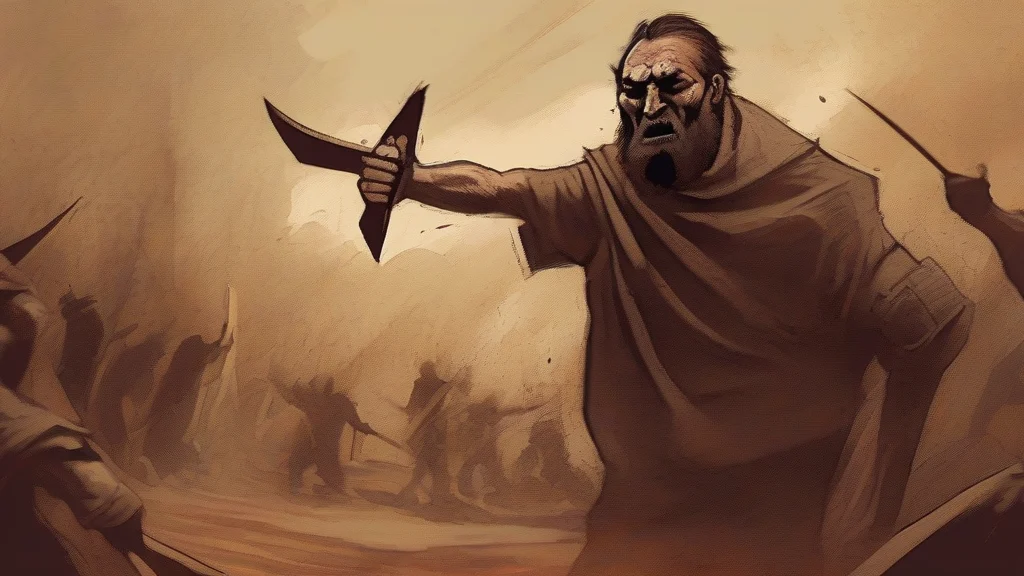
What does barbarity mean?
Barbarity is a noun denoting extreme cruelty, brutality, or savagery — either as an abstract quality of character or conduct, or as a reference to concrete vicious acts. It carries an intensely negative connotation and appears most often in formal contexts such as news reporting, historical accounts, human-rights documentation, and moral or political commentary, where writers use it to mark behavior as shocking and beneath the standards of civilized society. A secondary, now less frequent sense treats barbarity as crudeness or gross offensiveness to refined taste, extending the idea of the 'uncivilized' beyond violence into cultural coarseness. The word derives ultimately from the Greek 'barbaros,' meaning foreign or non-Greek-speaking, which entered Latin as 'barbarus' and passed through Old French before entering English in the early modern period. Because it overlaps with near neighbors like 'barbarism' and 'atrocity,' careful writers distinguish among them: barbarity emphasizes cruelty itself, atrocity names specific wicked deeds, and barbarism points to errors of language or lapses in refinement.
nounExtreme cruelty or brutality; a viciously inhumane act or quality. Also, more broadly, something crude, unrefined, or shocking to civilized taste.
- Extreme cruelty or savage brutality, whether as a quality or as concrete acts.
- Something crude, coarse, or offensively contrary to civilized taste or refinement (less common today).
"The report documented the barbarity inflicted on prisoners during the conflict."
"Witnesses described the barbarity of the regime's treatment of dissidents."
"Critics considered the demolition of the historic theater an act of cultural barbarity."
The plural 'barbarities' typically refers to multiple separate acts or instances of cruelty rather than degrees of a single quality.
"The tribunal catalogued dozens of barbarities carried out during the occupation."
The word traces back to ancient Greek 'barbaros' — the label Greeks gave anyone who didn't speak their language: all that foreign babble sounded like 'bar-bar-bar.'
Reviewed by Deb Chak, Editor. AI-assisted content curated by RJS Tech Solutions LLP.
Etymology of barbarity
Barbarity comes from the Greek 'barbaros,' meaning one who does not speak Greek — a foreigner whose language sounded like unintelligible 'bar-bar' muttering. The term passed into Latin as 'barbarus' and then via Old French into English, where 'barbarity' was established by the early 17th century as a noun for savage cruelty. It shares this root with cognates such as 'barbarian,' 'barbarous,' 'barbaric,' and 'barbarism.'
Related word forms
How barbarity is actually used
Formal register, common in journalism, history, and human-rights writing. Strongly negative connotation; often used rhetorically to condemn acts as beneath the standards of civilization.
Easily confused with barbarity
Barbarity refers to extreme cruelty or savagery of conduct, while barbarism refers chiefly to crudeness or incorrectness — in language, a grammatical or usage error; more broadly, uncivilized coarseness.
Atrocity denotes a specific shockingly wicked act, whereas barbarity can describe both the general quality of cruelty and individual acts of it.