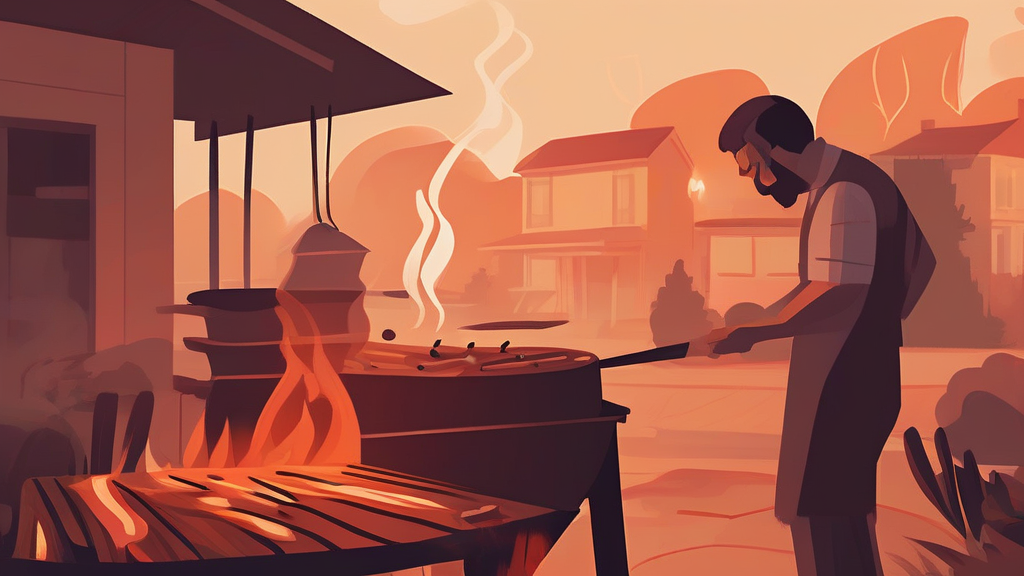
What does barbecue mean?
Barbecue refers both to a method of cooking — meat or other food prepared slowly over an open flame, hot coals, or wood smoke — and to the convivial outdoor gatherings built around that cooking. Used as a noun, it denotes the meal, the event, or the grill itself; used as a verb, it describes the act of grilling or smoking food, especially outdoors. The word evokes warmth, leisure, and community: backyard cookouts, park picnics, and summer holidays. It carries strong regional associations, from American styles like Texas brisket and Carolina pulled pork to the Australian 'barbie' and the South African 'braai'. Derived from the Taíno term 'barbacoa', the word carries centuries of history, linking modern patio grills to Indigenous Caribbean cooking techniques. Its versatility as both noun and verb, along with its rich sensory connotations of smoke, char, and shared meals, makes it one of the most culturally resonant terms in everyday English.
A meal or social gathering at which food, typically meat, is cooked outdoors over an open fire or grill; also the grill, pit, or apparatus used for such cooking.
"They hosted a barbecue in the garden to celebrate the end of the school year."
As a noun, barbecue can refer to the event, the food served there, or the equipment itself.
To cook food, especially meat, over an open flame or hot coals, often slowly and with wood smoke.
"He barbecued a rack of ribs over mesquite coals for six hours."
Standard plural; used for multiple events, meals, or pieces of grilling equipment.
"The restaurant sells three sizes of charcoal barbecues."
The word 'barbecue' comes from the Taíno people of the Caribbean, whose word 'barbacoa' described a wooden framework for smoking meat — meaning every cookout carries a piece of pre-Columbian history.
Reviewed by Deb Chak, Editor. AI-assisted content curated by RJS Tech Solutions LLP.
Etymology of barbecue
Barbecue derives from 'barbacoa', a word recorded by Spanish explorers describing the raised wooden frameworks the Taíno people of the Caribbean used to smoke and dry meat over fire. The Spanish adopted and carried the term into wider use during the colonial era, and English speakers borrowed it, with the word appearing in English texts by the early 17th century. Related forms include Spanish 'barbacoa' itself and the French-derived 'boucan', associated with the smoking frames used by buccaneers, giving rise to the term 'boucanier', which entered English as 'buccaneer'. Over time the word broadened from describing a cooking framework to encompass the entire practice and social ritual of outdoor cooking over fire.
How barbecue is actually used
In Australia, 'barbecue' is often shortened colloquially to 'barbie'; in South Africa the equivalent gathering is called a 'braai'. In American usage, regional styles (Texas brisket, Carolina pulled pork, Kansas City ribs) carry strong cultural identity. As a verb, 'barbecuing' is distinguished from simply 'grilling' when low, indirect heat and wood smoke are used.
Easily confused with barbecue
Broiling cooks food with direct overhead heat inside an oven, while barbecuing cooks it over an open flame or hot coals outdoors.