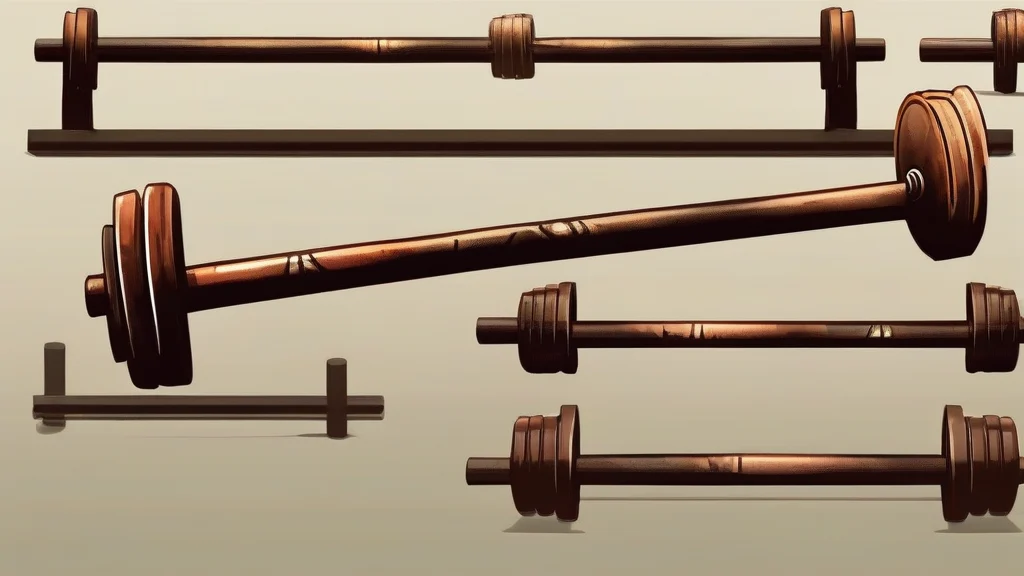
What does barbell mean?
A barbell is a piece of strength-training equipment consisting of a long metal bar, typically five to seven feet in length, onto which circular weight plates are loaded at each end. It is the central tool of weightlifting and powerlifting, used in exercises such as squats, deadlifts, bench presses, and overhead presses. Because both hands grip the same bar, the barbell allows lifters to move heavier loads than with separate handheld weights, making it the standard implement for building maximal strength. The term derives from 'bar' combined with 'bell,' reflecting the word's origin in the older term 'dumbbell.' Barbells come in fixed-weight and adjustable forms, with the standardized Olympic barbell weighing twenty kilograms for men and fifteen for women. The word is common in gyms, sports journalism, and fitness culture, and carries connotations of serious, disciplined training rather than casual exercise.
nounA bar used in weightlifting, typically a long metal rod to which discs of varying weight are attached at each end.
- A long metal bar with weighted discs attached at each end, used in weightlifting and strength training.
"She loaded another plate onto the barbell before attempting the deadlift."
"He gripped the barbell and pulled it smoothly off the floor."
"The gym's racks held barbells ranging from light training bars to heavy Olympic sets."
Regular plural; commonly used when referring to a gym's equipment or a range of bar types.
"The new gym stocked barbells of every length and weight."
The word 'barbell' literally borrows from church bells — early strength trainers swung bell-shaped weights whose clappers had been removed, leaving them 'dumb,' and the long bar version simply added 'bar' to the name.
Reviewed by Deb Chak, Editor. AI-assisted content curated by RJS Tech Solutions LLP.
Etymology of barbell
The word 'barbell' combines 'bar' with 'bell,' deriving from the earlier term 'dumbbell,' which referred to hand bells with their clappers removed so they made no sound — hence 'dumb.' Such silent bells were used for exercise in Britain by the eighteenth century, and when a longer bar version with weights at each end emerged in the nineteenth century, it was naturally named by adding 'bar' to the existing word. The term thus shares its root with 'bell' itself, a word of Germanic origin.
How barbell is actually used
Standard fitness vocabulary worldwide; no significant regional variation. In formal writing about sport science it appears alongside terms like 'free weights' and 'resistance training.'
Easily confused with barbell
A dumbbell is a short handheld weight, while a barbell is a long bar lifted with both hands and loaded with plates at each end.