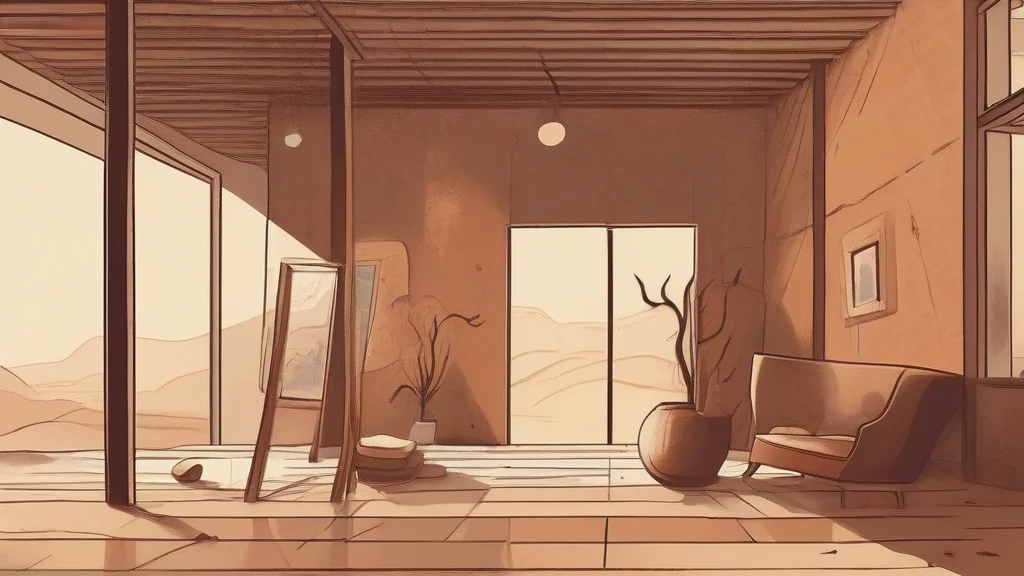
What does bareness mean?
Bareness is a noun describing the state or quality of being bare — whether stripped of covering, decoration, or contents. It captures everything from the austere emptiness of an unfurnished room to the deliberate simplicity of minimalist art or architecture. Unlike nakedness, which usually refers to unclothed bodies, bareness applies most naturally to spaces, surfaces, objects, and styles: the bareness of a wall, a stage set, or a writer's prose. Its connotations depend heavily on context — it can suggest bleakness, poverty, or discomfort on one hand, and purity, honesty, or elegant restraint on the other. The word derives from 'bare', an Old English adjective meaning uncovered or naked, combined with the noun-forming suffix '-ness'. Because it is easily confused with 'barrenness' (infertility or unproductiveness), careful writers distinguish between them: a field may be barren, while a table may be bare. Bareness remains a useful, evocative term in literary criticism, interior description, and aesthetic discussion.
The state or quality of being bare; absence of covering, decoration, or adornment.
"The bareness of the stage focused all attention on the actors' performances."
Often used in descriptions of interiors, landscapes, and minimalist aesthetics.
Emptiness or sparseness; the condition of lacking contents, comfort, or embellishment.
"A certain bareness pervaded the house after the furniture was sold."
This sense can carry connotations of poverty, austerity, or bleakness depending on context.
Rarely used in the plural; bareness is almost always treated as an uncountable abstract noun.
"The novel catalogues the barenesses of modern urban life."
Bareness and barrenness differ by just one letter — but one describes an empty room, and the other describes land that cannot grow crops.
Reviewed by Deb Chak, Editor. AI-assisted content curated by RJS Tech Solutions LLP.
Etymology of bareness
Bareness is formed from the Old English adjective 'bær' (bare), meaning naked or uncovered, combined with the suffix '-ness', which turns adjectives into abstract nouns. The root 'bare' is Germanic in origin, with cognates in other Germanic languages such as Old High German 'bar' and Dutch 'baar'. As an English formation, bareness emerged through straightforward derivation from its parent adjective rather than borrowing, and it has long served as the standard abstract noun for the state of being bare.
Related word forms
How bareness is actually used
Bareness is a relatively formal or literary word, more common in descriptive writing about interiors, landscapes, or artistic styles than in everyday conversation. In many contexts, 'bareness' and 'nakedness' overlap, but nakedness typically applies to bodies while bareness applies more broadly to objects, rooms, walls, and surfaces. The related word 'barrenness' is frequently confused with it but carries a distinct meaning of infertility.
Easily confused with bareness
Barrenness refers specifically to infertility or unproductiveness (of land, animals, or people), while bareness refers to a lack of covering, decoration, or contents.