
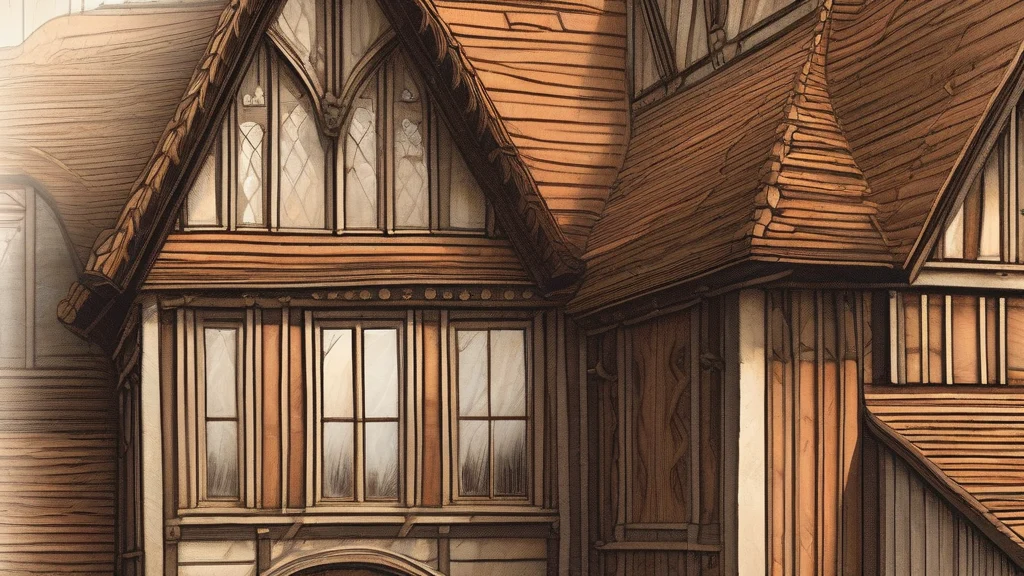
What does bargeboard mean?
A bargeboard is an ornamental board fitted along the sloping edges of a gable roof, where it conceals the projecting ends of the rafters and finishes the junction between roof and wall. Especially associated with Gothic Revival and Tudor-style buildings of the nineteenth century, bargeboards were frequently carved with elaborate scrollwork, giving rise to the affectionate label 'gingerbread trim' on Victorian cottages. The word also has a second, entirely unrelated life in motorsport, where it names aerodynamic panels mounted low along the sides of racing cars to shape airflow around the bodywork. In ordinary speech, however, the architectural sense dominates, and the term appears chiefly in building, restoration, and heritage contexts. Its American near-equivalent is 'vergeboard', and it sits alongside related trim elements such as the fascia and soffit.
An ornamental board fixed along the sloping edge of a gable roof to cover the projecting ends of the rafters.
"Carved oak bargeboards crowned each gable of the Tudor-revival manor."
Often called 'vergeboard' in American usage.
In motorsport, an aerodynamic panel mounted low on a racing car's flank to direct airflow.
"The new bargeboard design reduced drag noticeably in high-speed corners."
Restricted to technical racing commentary; many series banned complex bargeboards from 2022.
Regular plural; typically used when referring to multiple gables or paired boards on one roof.
"Both gables of the barn retain their original bargeboards."
The same word that describes Victorian gingerbread trim on a cottage gable also names the aerodynamic fins bolted beneath Formula 1 cars — bargeboards went from roof decoration to downforce engineering.
Reviewed by Deb Chak, Editor. AI-assisted content curated by RJS Tech Solutions LLP.
Etymology of bargeboard
The word combines 'barge' — here meaning a broad, flat board rather than the vessel — with 'board', forming a compound recorded in English by the early nineteenth century for the decorative gable trim of Gothic Revival architecture. The underlying word 'barge' entered English through Old French from medieval Latin, sharing distant origins with ship-related words such as 'barque'. Despite its nautical-sounding first element, the architectural term has no direct connection to boats; the compound arose simply from the resemblance of the wide gable board to a flat barge-like plank.
How bargeboard is actually used
In everyday usage 'bargeboard' almost always refers to the architectural element; the motorsport sense appears mainly in racing journalism and technical commentary. In North America the synonymous term 'vergeboard' is also common.
Easily confused with bargeboard
A fascia is the horizontal board running along the eaves at the bottom edge of the roof, whereas a bargeboard runs along the sloping rake of a gable.
Vergeboard is essentially the American synonym for bargeboard, both referring to the same gable-edge trim.