
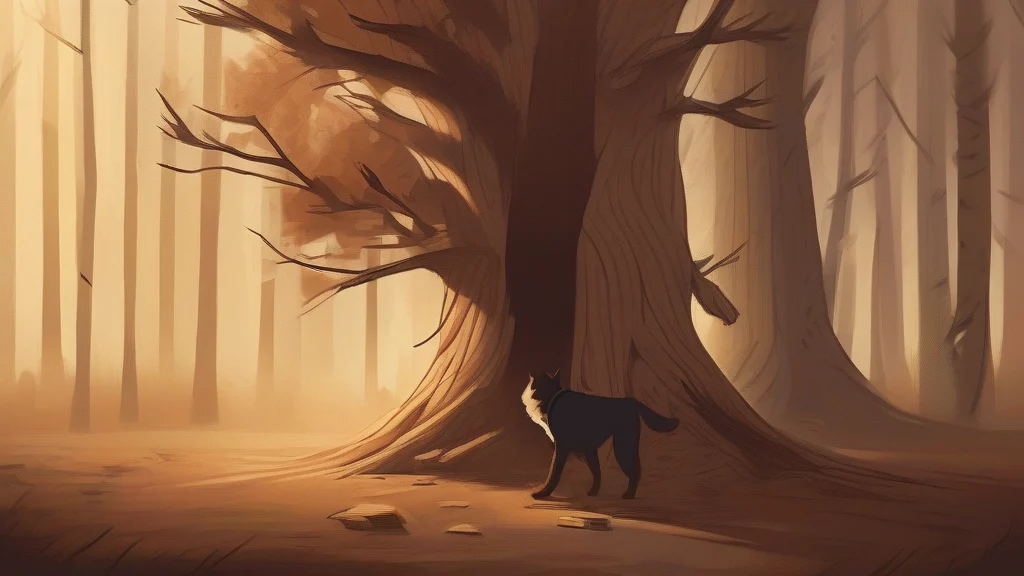
What does barkless mean?
"Barkless" is an adjective describing something that makes no bark, applied most often to dogs and other animals that remain conspicuously silent where barking would be expected. A barkless watchdog, for instance, fails to give vocal alarm, and the term is sometimes used of breeds such as the Basenji, which characteristically does not bark in the conventional sense. A secondary, much rarer sense applies to trees or woody stems that lack their outer layer of bark, whether naturally or because it has been stripped away. The word is formed simply by attaching the negative suffix "-less" to "bark," and it remains a relatively infrequent item in general usage, appearing mostly in descriptive prose about animals, hunting, or woodland. Its connotations depend on context: a barkless dog may suggest eeriness, stealth, or an unusual calm, while a barkless trunk suggests damage or exposure. For writers seeking a precise, evocative way to describe silence where a bark should be, it offers a compact and vivid option.
Not barking; silent, especially of a dog or other animal that gives no bark.
"The barkless guard dog let the fox cross the yard unnoticed."
The dominant sense in modern usage.
Lacking bark; (of a tree or stem) stripped of or without its outer covering.
"The beaver had gnawed the sapling down to a smooth, barkless pole."
A rarer sense, confined to descriptions of trees and wood.
A barkless dog sounds like a contradiction in terms — yet breeds like the Basenji are famous for exactly that, yodeling instead of barking.
Reviewed by Deb Chak, Editor. AI-assisted content curated by RJS Tech Solutions LLP.
Where does barkless come from?
"Barkless" is formed within English from the noun "bark" plus the suffix "-less," following a productive Germanic pattern of negation. The word "bark" denoting a dog's cry has a long history in English, with related forms traceable to Old English, though its ultimate origin is uncertain. The adjective arose as a straightforward derivational combination rather than being borrowed, so it shares its history with the everyday English word "bark" itself.
How barkless is actually used
An uncommon descriptive adjective, used almost exclusively in literal contexts about animals or trees rather than figuratively. The animal sense is by far the more frequent of the two.
Easily confused with barkless
"Bark" is either the sharp cry of a dog or the protective outer layer of a tree trunk, whereas "barkless" describes something that lacks that cry or covering.